
Introduction: The Heartbeat of Your Auto Budget
When you step onto a car dealership lot or browse listings online, the price tag staring back at you might seem manageable. However, the true cost of ownership often lies hidden in the monthly payment structure. Whether you are leasing a new electric sedan, financing a rugged pickup truck, or buying a reliable used commuter, understanding how your monthly car payment is calculated is crucial for maintaining financial health. This is where the monthly car payment calculator becomes an indispensable tool. It transforms abstract numbers into concrete reality, allowing you to predict exactly how much cash will leave your account each month and helping you avoid the common pitfall of “payment stretching”—where you buy more car than you can afford because you focus solely on the monthly figure rather than the total cost.
In this comprehensive guide, we will dissect every component that goes into calculating a monthly car payment. We will explore the mathematics behind it, the variables that influence it, the difference between fixed and variable rates, and how to use a calculator effectively to negotiate better deals. By the end of this article, you will have the knowledge to walk into any dealership with confidence, armed with precise numbers that empower your decision-making process.
What Is a Monthly Car Payment Calculator?
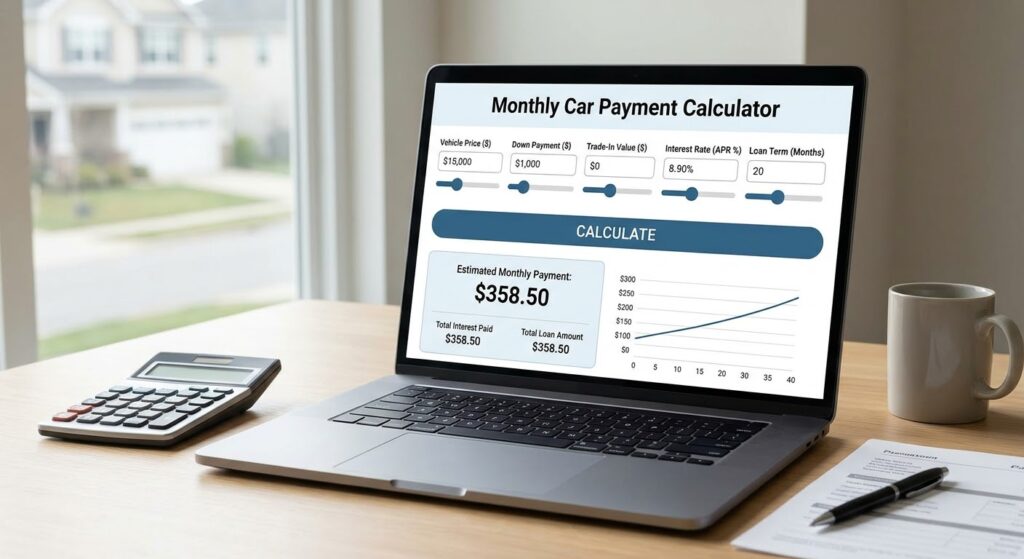
At its core, a monthly car payment calculator is a mathematical engine that determines the periodic installment required to pay off a loan over a specified period. It takes several key inputs—such as the vehicle’s purchase price, the down payment amount, the interest rate (APR), the loan term (duration), and sometimes sales tax and trade-in value—and applies them to a standard amortization formula.
For consumers, this tool serves two primary functions. First, it provides transparency. Without a calculator, dealerships often present complex packages where the monthly payment includes insurance, warranties, and gap coverage, making it difficult to isolate the actual loan cost. Second, it aids in budgeting. By adjusting the sliders in a calculator—increasing the down payment or shortening the loan term—you can see instantly how these changes affect your monthly outflow. This dynamic interaction helps buyers find the “sweet spot” where they get a car they like without straining their monthly budget.
The Anatomy of a Car Payment
To truly master the calculator, you must understand the variables it manipulates. A monthly car payment is not just a simple division of the loan amount by the number of months. It is a complex calculation involving principal, interest, and time. Here are the critical components:
1. Vehicle Purchase Price
This is the starting point. It is the negotiated price of the car, excluding taxes and fees. Note that this is different from the Manufacturer’s Suggested Retail Price (MSRP). The MSRP is the sticker price, but few people pay that full amount. The purchase price is what you actually agree to pay. A higher purchase price directly increases your monthly payment, but understanding negotiation leverage can lower this number significantly.
2. Down Payment
A down payment is the upfront cash you pay toward the vehicle. This reduces the principal amount you need to borrow. For example, if a car costs $30,000 and you put down $5,000, your loan principal starts at $25,000. A larger down payment lowers your monthly payment and reduces the total interest paid over the life of the loan. Some experts recommend a down payment of at least 20% to ensure you don’t end up “upside down” on your loan (owing more than the car is worth) early in the repayment period.
3. Trade-In Value
If you are trading in an existing vehicle, its value is applied against the purchase price of the new car. This acts similarly to a down payment. However, it is crucial to know the fair market value of your trade-in beforehand. Dealerships often bundle the trade-in value with the new car price, which can obscure the actual discount you are receiving. Using a calculator allows you to input the trade-in value separately to see its exact impact on your monthly payment.
4. Interest Rate (APR)
The Annual Percentage Rate (APR) is the cost of borrowing money, expressed as a yearly percentage. It is determined by your credit score, income stability, debt-to-income ratio, and current economic conditions. A lower APR means less interest charged over the life of the loan, resulting in a lower monthly payment. Conversely, a high APR can add thousands of dollars to the total cost of the vehicle. It is essential to distinguish between the prime rate offered to borrowers with excellent credit and subprime rates for those with lower scores.
5. Loan Term (Duration)
The loan term is the length of time you have to repay the loan, typically measured in months. Common terms include 36, 48, 60, 72, or even 84 months. There is a fundamental trade-off here: longer loan terms result in lower monthly payments because the principal is spread out over more months. However, they also mean you pay more in total interest. Shorter loan terms have higher monthly payments but save you significant money in interest and help you build equity faster.
6. Sales Tax and Fees
While some calculators focus purely on the loan mechanics, a complete picture requires including sales tax, registration fees, title fees, and documentation fees. These costs are often rolled into the loan amount, increasing the principal. If you pay sales tax upfront, it does not affect your monthly payment. Understanding whether tax is included in the financed amount is vital for accurate calculations.
The Mathematics Behind the Calculator
How does the calculator actually arrive at the number? Most auto loans use an amortized loan structure. This means each payment covers both the interest accrued for that period and a portion of the principal. In the early stages of the loan, a larger portion of your payment goes toward interest, while later payments are primarily applied to the principal.
The standard formula used by most monthly car payment calculators is derived from the annuity formula:
$$ M = P \frac{r(1+r)^n}{(1+r)^n – 1} $$
Where:
- M = Monthly payment
- P = Principal loan amount (Purchase Price + Tax/Fees – Down Payment – Trade-In)
- r = Monthly interest rate (Annual Rate divided by 12)
- n = Total number of payments (Loan Term in months)
Let’s break down why this matters. If you have a high interest rate, the variable r increases, which exponentially increases M. Similarly, if you extend n (the loan term), the denominator grows, reducing M, but the total interest paid increases because you are carrying the balance longer. Understanding this formula helps you predict how small changes in one variable ripple through the entire system.
Fixed vs. Variable Interest Rates
When using a calculator, you must decide whether to assume a fixed or variable interest rate.
Fixed-Rate Loans: The interest rate remains constant throughout the life of the loan. This is the most common type of auto loan. The benefit is predictability; your monthly payment never changes, making budgeting straightforward. Calculators for fixed-rate loans are simpler and more widely used because the output is stable.
Variable-Rate Loans: The interest rate can fluctuate based on an index, such as the prime rate or LIBOR. If market rates rise, your monthly payment may increase after an adjustment period. Variable-rate loans often start with a lower initial rate but carry more risk. Calculators for variable loans usually require an estimate of future rate changes or show a range of possible payments. For most consumers, fixed-rate loans are preferable due to their stability, unless you plan to pay off the loan quickly before rates adjust.
Leasing vs. Financing: Different Calculations
It is crucial to distinguish between financing a car and leasing it, as the calculations differ significantly. A monthly car payment calculator for financing calculates the payoff of the entire asset. A lease payment calculator, however, focuses on the depreciation of the vehicle plus the finance charge.
In a lease, you are paying for the difference between the car’s value when you drive it off the lot and its projected value at the end of the lease term (residual value). You do not own the car at the end unless you exercise a buyout option. Lease payments are often lower than loan payments because you are only covering the depreciation, not the entire purchase price. However, leases come with mileage restrictions, wear-and-tear fees, and no equity buildup. When comparing a lease to a loan, use separate calculators for each to ensure an apples-to-apples comparison.
How to Use a Monthly Car Payment Calculator Effectively
Knowing the theory is good, but applying it is better. Here is a step-by-step guide to using a calculator strategically during your car-buying journey.
Step 1: Determine Your Budget Beforehand
Before visiting the dealership, determine the maximum monthly payment you can comfortably afford. Financial advisors often suggest that total transportation costs (including insurance, fuel, and maintenance) should not exceed 15-20% of your take-home pay. Use the calculator to work backward from this number. If you want a $400 monthly payment, what is the maximum car price you can afford given current interest rates and a 60-month term?
Step 2: Experiment with Variables
Use the calculator’s interactive features to test scenarios.
- Scenario A: Keep the car price and term constant, but increase the down payment. How much does the payment drop?
- Scenario B: Keep the down payment constant, but shorten the loan term from 72 months to 48 months. How much does the payment increase, and how much interest do you save?
- Scenario C: Compare two different cars. One has a lower price but higher interest rate; the other has a higher price but a promotional low rate. Which results in a lower monthly payment?
Step 3: Include Hidden Costs
Many online calculators ignore sales tax. To get a realistic number, manually add your state’s sales tax to the purchase price before entering it into the calculator. Also, consider adding estimated monthly insurance costs to your “total monthly outflow” to see the true burden on your wallet.
Step 4: Negotiate Using the Number
Dealers often try to distract you with monthly payments. Instead of saying, “I want a car under $500 a month,” say, “Based on my calculations, I can afford a $500 payment on a 60-year loan at 6% interest, which means I can spend up to $28,000 on the vehicle.” This shifts the conversation from the payment to the price, giving you more control over the negotiation.
Common Mistakes to Avoid
Even with a calculator, buyers can fall into traps. Here are common errors to watch for:
1. Focusing Solely on the Monthly Payment
A dealer might offer a 7-year loan with a very low monthly payment, but you end up paying significantly more in interest and owning the car later. Always look at the total cost of the loan (monthly payment x number of months + down payment). A slightly higher monthly payment on a shorter term often saves you thousands.
2. Rolling Negative Equity into the New Loan
If you owe more on your trade-in than it is worth, that negative equity can be added to your new loan. This inflates the principal, leading to higher payments and potentially being underwater immediately. Calculate this carefully. If your trade-in is worth $15,000 but you owe $18,000, that extra $3,000 is added to your new loan.
3. Ignoring Prepayment Penalties
Some older loan agreements include prepayment penalties, meaning you pay extra if you pay off the loan early. While rare in modern auto lending, it is worth checking. A calculator won’t tell you this; you must read the fine print.
4. Assuming All Interest Rates Are Equal
Your credit score dramatically affects your rate. A person with a 750 credit score might get 4% APR, while someone with a 600 score might get 8%. This difference can add hundreds of dollars to your monthly payment. Check your credit report before shopping to ensure you are getting the best possible rate.
Advanced Strategies for Lower Payments
If your calculated payment is still too high, consider these advanced strategies:
Extend the Loan Term Wisely
Moving from a 60-month to a 72-month loan can reduce payments by 10-15%. However, calculate the total interest cost. If the interest savings are minimal compared to the convenience of lower payments, it might be worth it. But beware of “loan stacking,” where you are still paying for the old car while taking on a new one.
Make Larger Down Payments
As mentioned earlier, a larger down payment reduces the principal. If you can afford a 20-30% down payment, you not only lower your monthly bill but also reduce the risk of negative equity.
Choose a Less Expensive Trim Level
Often, the base model offers the same mechanical reliability as the top-tier trim but lacks cosmetic upgrades. The payment difference can be substantial. Use the calculator to compare the base model versus the upgraded version to see if the luxury features are worth the extra monthly cost.
Buy Used
New cars depreciate rapidly, losing up to 20% of their value in the first year. Buying a certified pre-owned (CPO) vehicle allows you to avoid the steepest part of the depreciation curve. The monthly payment for a three-year-old car is often significantly lower than for a brand-new model, and the interest rates are competitive.
The Role of Technology in Modern Calculators
Today’s calculators are more sophisticated than simple arithmetic tools. Many dealership websites and banking apps now offer dynamic calculators that pull real-time interest rates from multiple lenders. Some even integrate with your credit score to give you personalized rate estimates. Others allow you to input specific fees, such as destination charges or dealer prep fees, providing a hyper-localized calculation.
Additionally, some advanced calculators offer amortization schedules. These detailed tables show exactly how much of each payment goes to principal vs. interest over the life of the loan. This is invaluable for understanding when you will build equity and whether refinancing makes sense later.
Conclusion: Empowerment Through Calculation
The monthly car payment calculator is more than just a number generator; it is a window into the financial reality of your car purchase. By understanding the variables—price, down payment, interest rate, and term—you gain the power to manipulate these levers to fit your budget. Whether you are negotiating with a dealer, comparing lease vs. buy options, or simply trying to stay within your means, a solid grasp of these calculations ensures you make informed decisions.
Remember, the lowest monthly payment is not always the best deal. The goal is to find a balance between affordability and total cost. Use the calculator repeatedly, experiment with different scenarios, and never sign a contract until you fully understand the numbers behind the payment. In the world of auto finance, knowledge is indeed power, and the calculator is your greatest ally.
Frequently Asked Questions (FAQ)
Q: Does a higher credit score always mean a lower monthly payment?
A: Yes, generally. A higher credit score qualifies you for lower interest rates, which reduces the total interest charged and thus lowers your monthly payment for the same loan amount and term.
Q: Can I use a monthly car payment calculator for commercial vehicles?
A: Yes, though commercial loans may have different terms, such as balloon payments or shorter durations. Ensure the calculator allows you to input custom loan terms and interest structures.
Q: How does a balloon payment affect the calculation?
A: A balloon payment is a large lump sum due at the end of the loan term. This reduces the monthly payments because the principal is not fully amortized over the term. Calculators that support balloon payments will deduct the balloon amount from the total principal before calculating the monthly installments.
Disclaimer: The information provided in this article is for educational and informational purposes only and does not constitute financial, legal, or tax advice. While we strive to provide accurate and up-to-date data regarding car loans, interest rates, and payment structures, these figures can change rapidly based on market conditions, lender policies, and individual credit profiles. Always consult with a qualified financial advisor, auto loan specialist, or your local bank before making significant financial decisions. This content should not be used as the sole basis for purchasing a vehicle; verify all calculations with your specific lender.