
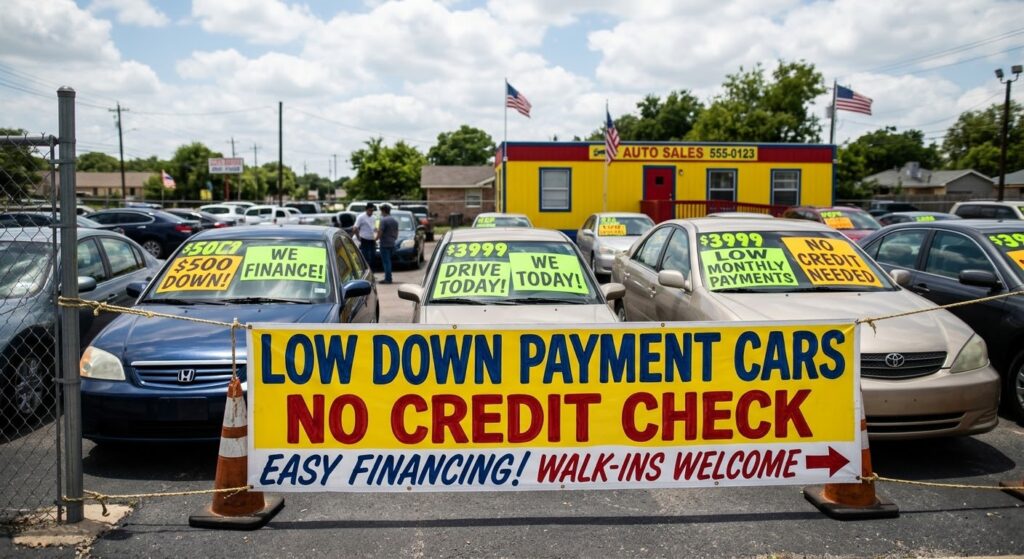
For millions of Americans, the dream of owning a reliable vehicle is often held hostage by two formidable gatekeepers: a lack of immediate cash for a substantial down payment and a credit history that looks more like a blank page than a record of responsibility. Traditional auto financing has long operated on a rigid binary system. You either have excellent credit and low interest rates, or you are deemed “subprime” and forced to pay premium prices for inferior vehicles. This system leaves a massive demographic stranded—people who work hard, have steady income, but simply haven’t had the time, luck, or financial literacy to build a perfect credit score. Enter the world of low down payment cars no credit check. This phrase has become a beacon of hope for those excluded from the traditional banking system, promising access to wheels without the need for a fortune in savings or a pristine FICO score. However, navigating this landscape requires more than just finding a dealership that accepts pennies; it requires understanding the hidden mechanics of these deals, the true cost of convenience, and how to avoid predatory traps that can leave you upside-down on your loan for years. This article dives deep into the realities of buying a car with little money down and no credit verification, offering a comprehensive roadmap for securing affordable transportation while protecting your financial future.
Understanding the Landscape: What Does “No Credit Check” Really Mean?
Before diving into specific strategies, it is crucial to demystify the terminology used in marketing campaigns. When a dealership advertises “no credit check,” they rarely mean they will ignore your financial history entirely. Instead, they typically refer to “soft pull” inquiries or alternative data scoring. A traditional lender performs a “hard pull,” which temporarily dents your credit score by a few points. A “no credit check” dealer might use soft pulls that do not affect your score, or they may look at your bank statements, employment history, and utility payments to gauge your ability to pay rather than your past borrowing behavior. Furthermore, many of these dealers work with subprime lenders who specialize in high-risk borrowers. These lenders are willing to take on higher risks because they charge higher interest rates to compensate for the likelihood of default. Therefore, “no credit check” is often shorthand for “we don’t care about your credit score, but we do care about your ability to pay, and we will charge you accordingly.”
The appeal is obvious. If you have been denied by banks due to a past bankruptcy, a series of late payments, or simply being a young adult with no credit history, these options open doors that were previously locked. They provide a pathway to rebuild trust with financial institutions. Making timely payments on a “no credit check” loan can eventually boost your credit score, provided the lender reports to the major credit bureaus (a detail you must verify before signing). This creates a virtuous cycle where your current struggle leads to future financial freedom. However, the cost of entry is rarely free of drawbacks, and understanding the trade-offs is essential.
The Mathematics of Low Down Payments
A low down payment reduces the barrier to entry, but it significantly increases the total cost of the vehicle over the life of the loan. Let’s break down the mechanics. Suppose you want to buy a $15,000 car. With a traditional 20% down payment, you would pay $3,000 upfront, leaving a principal balance of $12,000. With a “low down payment” deal requiring only 5%, you pay just $750 upfront. While this saves you $2,250 in immediate cash flow, it means you are financing $14,250 instead of $12,000. Because the principal is higher, the interest charges accumulate faster.
Moreover, low down payment deals often come with longer loan terms, such as 72, 84, or even 96 months. Extending the term lowers your monthly payment, making it seem affordable, but it dramatically increases the total interest paid. For example, a 7-year loan at 12% interest on $14,250 could result in total payments exceeding $22,000. You end up paying nearly $8,000 in interest alone, compared to maybe $2,000–$3,000 on a standard 5-year loan. The key takeaway is that low down payments shift the burden from today to tomorrow. It is a tool for liquidity management, not necessarily a bargain. Buyers must calculate the total cost of ownership, including interest, taxes, and fees, not just the monthly sticker price.
Where to Find Low Down Payment, No Credit Check Deals
Finding these deals requires looking beyond the big box dealerships that cater to prime borrowers. Several avenues exist for the credit-challenged buyer:
- Buy Here Pay Here (BHPH) Dealerships: These are the most common source of no credit check cars. BHPH dealers finance the car themselves rather than using an external bank. They keep the inventory small, often consisting of older, used cars priced between $5,000 and $15,000. Since they hold the note, they can set their own rules regarding down payments and credit requirements. Many require down payments as low as $500 to $1,000. The downside is that interest rates can be exorbitant, sometimes exceeding 20-30%. Additionally, BHPH lots often have strict repossession policies; if you miss a payment by even one day, they may repossess the car quickly, often without giving you much grace period.
- Subprime Lenders and Credit Unions: Some local credit unions are more community-focused and may offer “second chance” auto loans with lower down payments. They often look at your debt-to-income ratio rather than just your credit score. Subprime lenders like First Finance Auto or similar specialized firms work with various dealers to offer competitive, albeit higher-than-average, rates. These loans usually require a moderate down payment (around 10%) but are more forgiving of credit blemishes.
- Private Sellers with Flexible Terms: Occasionally, private sellers are willing to accept installment payments directly from buyers. This bypasses the dealership markup and financing fees. However, this requires careful legal structuring to ensure the title is held in escrow until the loan is paid off. It is less common but can offer better rates if you negotiate well.
- Online Marketplaces: Platforms like Carvana, Vroom, and Shift have expanded into subprime markets. While they primarily target prime borrowers, some partners offer flexible down payment options. Always read the fine print regarding credit checks and pre-approval processes.
Step-by-Step Strategy for Securing the Deal
Securing a low down payment, no credit check car involves preparation and negotiation. Here is a strategic approach:
Step 1: Check Your Own Status
Even if the dealer says “no credit check,” knowing your status helps you negotiate. Use free services like AnnualCreditReport.com to review your report. Identify any errors that could be disputed. Also, calculate your maximum affordable monthly payment. A good rule of thumb is that your car payment should not exceed 10-15% of your take-home pay.
Step 2: Gather Documentation
Since they aren’t looking at your credit score, they will scrutinize your ability to pay. Prepare proof of income (pay stubs, bank statements), proof of residence (utility bills, lease agreement), and a valid driver’s license and insurance. Having these documents ready shows you are organized and serious, which can sway a dealer to approve a smaller down payment.
Step 3: Shop Around Aggressively
Visit at least three to five BHPH dealerships or subprime lenders. Each has different criteria. One might require a $1,000 down payment but charge 18% interest, while another might accept $500 down but charge 25%. Compare the total cost, not just the monthly payment. Ask for a written breakdown of all fees, including documentation fees, add-ons, and interest rates.
Step 4: Negotiate the Price, Not Just the Payment
Dealers love to focus on the monthly payment. They might stretch the loan term to 84 months to make the payment look low, but you’ll pay more overall. Insist on negotiating the purchase price of the car first. Once the price is agreed upon, then discuss the down payment and terms. Remember, the down payment is part of the price. If you can afford a slightly larger down payment, ask for a reduction in the interest rate.
Step 5: Read the Contract Carefully
Pay attention to clauses regarding prepayment penalties. Some contracts charge a fee if you pay off the loan early, preventing you from saving on interest. Look for “balloon payments,” where a large lump sum is due at the end of the term. Ensure you understand the repossession process. How many days’ grace period do you get? Is there a late fee?
Common Pitfalls and Hidden Costs
While low down payment, no credit check cars offer accessibility, they come with significant risks. Being aware of these pitfalls can save you thousands of dollars.
High Interest Rates: As mentioned, expect rates between 12% and 30%. A high rate means a larger portion of your payment goes toward interest rather than principal. In the early years of the loan, you might barely be chipping away at the balance. This is known as negative equity.
Add-On Products: Dealerships often try to sell extended warranties, gap insurance, paint protection, and nitrogen tire fills. These can add $1,000 to $3,000 to your loan. Many are unnecessary. Gap insurance is useful if you have a low down payment because if the car is totaled, the insurance payout might be less than what you owe. However, you can often buy gap insurance separately from your auto insurer for cheaper. Extended warranties from dealers are often marked up significantly compared to manufacturer-backed plans.
Repossession Risk: BHPH dealers are notorious for quick repossessions. Some have trackers installed in every car. If you miss a payment, they may tow the car within 24 hours. This can disrupt your job and life, and you lose your down payment and equity. Choose a dealer with a reputation for fairness if possible.
Poor Vehicle Condition: To maximize profit, BHPH dealers often buy cars at auction that need minor repairs. They perform minimal maintenance and sell them “as-is.” Be prepared for potential mechanical issues. Have a mechanic inspect the car if possible, or at least get a vehicle history report to check for accidents and odometer discrepancies.
Rebuilding Credit Through Auto Financing
One of the biggest benefits of a no credit check car is the opportunity to rebuild your credit. However, this is not automatic. You must ensure the lender reports to the three major credit bureaus: Equifax, Experian, and TransUnion. Ask the dealer or lender specifically: “Do you report my payments to the credit bureaus?” If they say yes, make sure you get this in writing. Consistent, on-time payments will gradually increase your score. After 12-18 months of perfect payments, you may qualify for better loans from traditional banks, allowing you to refinance your current loan at a lower rate. This refinancing can save you thousands in interest and reduce your monthly payment.
Alternatives to Consider
If low down payment cars still seem too risky or expensive, consider these alternatives:
Leasing a Used Car: Some leasing programs allow lower down payments and may have more lenient credit requirements. Leasing builds less equity but offers lower monthly payments and the benefit of driving a newer car with fewer repair costs.
Public Transportation or Ride-Sharing: If your primary goal is mobility rather than ownership, reducing expenses on a car might be smarter. Calculate the total cost of ownership (insurance, gas, maintenance, depreciation) versus ride-sharing costs. For short commutes, this might be more economical.
Co-Signers: If you have a family member or friend with good credit, they can co-sign your loan. This often results in better rates and lower down payments. However, remember that their credit is on the line. If you miss a payment, it affects their score too.
Conclusion
Buying a low down payment car no credit check is a viable strategy for accessing reliable transportation when traditional financing is out of reach. It offers flexibility, accessibility, and a path to credit rebuilding. However, it is not a cheap option. The convenience of low upfront costs comes at the price of higher total interest, longer loan terms, and stricter repossession terms. Success depends on careful shopping, understanding the true cost of the deal, and maintaining disciplined payment habits. By avoiding unnecessary add-ons, negotiating the price effectively, and ensuring credit reporting, you can turn a potentially predatory deal into a stepping stone toward financial stability. Remember, the goal is not just to get a car, but to get a car that serves your needs without dragging you into long-term debt. Do the math, read the contract, and drive with confidence.
Disclaimer: This article is for informational purposes only and does not constitute financial, legal, or professional advice. Auto financing terms, interest rates, and dealer practices vary widely by region, lender, and individual circumstances. Always read the fine print in any loan agreement, verify all claims about credit reporting and fees, and consult with a qualified financial advisor or attorney before making significant financial decisions. The information provided here is based on general market trends and may not reflect current local conditions or specific contractual obligations.