
Buying a used car is often viewed as the smartest financial move an individual can make in the automotive world. The depreciation curve flattens out significantly after the first few years, meaning you get more car for your money compared to buying new. However, while the purchase price might be lower, the financing landscape for pre-owned vehicles is far more complex and fragmented than it is for brand-new cars. Lenders perceive used cars as higher risk due to uncertainty about the vehicle’s condition and future resale value, which translates to stricter requirements and varied interest rates.
To secure the best deal, you need to understand the specific financing options available, how they differ, and which one aligns with your financial health. This guide breaks down every major avenue for used car financing, from traditional bank loans to creative lease-end deals, helping you navigate the process with confidence.
1. Bank and Credit Union Auto Loans
For many buyers, starting with their existing financial institutions is the most logical first step. Both large national banks and smaller local credit unions offer auto loans specifically for used vehicles.
Why Credit Unions Are Often Superior
If you are eligible, credit unions (CU) are frequently the gold standard for used car financing. Because credit unions are not-for-profit cooperatives owned by their members, they tend to offer lower interest rates and fewer hidden fees than big banks. They also have more flexibility when it comes to underwriting. If your credit score isn’t perfect but you have a solid payment history with them, a local credit union might be willing to work with you in a way a rigid algorithm at a mega-bank wouldn’t.
The Bank Approach
Banks offer convenience and speed. If you already have a checking account or a mortgage with a major bank, applying for their auto loan can often be done entirely online. The downside is that banks are generally more conservative. They may require a higher credit score threshold and offer less competitive rates on older vehicles. Additionally, banks often have strict age and mileage caps; if you are looking at a car that is ten or fifteen years old, a bank might decline the loan simply because the collateral is considered “high risk.”
Pros:
- Competitive rates for those with excellent credit.
- Convenience of dealing with a known institution.
- Fast approval processes.
Cons:
- Strict eligibility criteria.
- Less flexibility on older/high-mileage vehicles.
- Rates may not be as low as credit unions or specialized lenders.
2. Dealer Financing (Captive Finance)
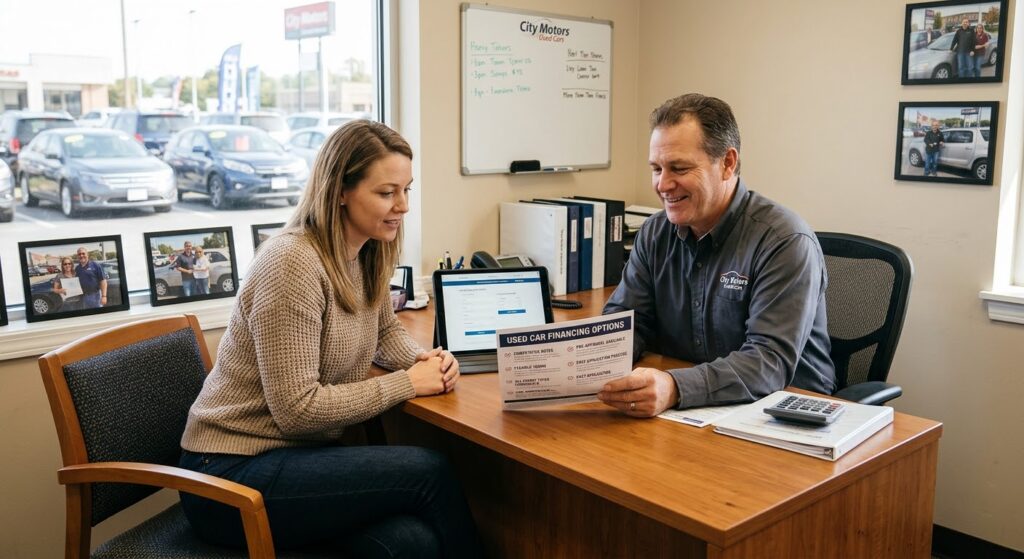
When you walk into a dealership—whether it’s a franchise dealer selling certified pre-owned (CPO) cars or an independent lot—they will almost certainly offer to finance the deal right there. This is often referred to as “dealer financing.”
How It Works
The dealer acts as an intermediary. They present you with a rate, which they then sell to a third-party lender (often a captive finance arm like Toyota Financial Services or Ford Credit, though independent lenders also buy these loans). The dealer makes money on the “spread”—the difference between the rate they offered you and the actual wholesale rate they secured from the lender.
The Power of “Subprime” Lending
One of the biggest advantages of dealer financing is access to subprime lending. If you have a blemished credit history, dealers have relationships with “buy-here-pay-here” lots and specialized subprime lenders who might reject you elsewhere. They can structure loans with higher interest rates to offset the risk, getting you into a car when other doors are closed.
Watch Out for Add-Ons
Dealer financing is notorious for padding the final number with add-on products like extended warranties, gap insurance, and tire-and-brake plans. These are often rolled into your loan balance, increasing your monthly payment and the total interest you pay over the life of the loan. Always ask for the “out-the-door” price before discussing financing to ensure you aren’t paying extra for products you don’t need.
Pros:
- One-stop shopping (car selection + financing).
- Access to subprime borrowers.
- Potential for flexible terms (e.g., longer loan durations up to 84 months).
Cons:
- Interest rates can be higher than direct bank loans.
- Hidden fees and aggressive sales tactics.
- You may not get the absolute lowest market rate.
3. Online Direct Lenders
In the last decade, the rise of fintech companies has disrupted traditional auto lending. Companies like LightStream, Discover Auto Loans, or SoFi allow you to apply for a used car loan entirely online, often before you even find the car you want to buy.
Pre-Approval Power
The superpower of online lenders is pre-approval. You can submit your information, run a soft credit check, and receive a conditional offer within minutes. Once you have a pre-approved loan amount and rate, you can go to any dealership or private seller and negotiate from a position of strength. You know exactly what your budget is, and the dealer knows you have the cash ready to go.
Flexibility and Speed
Online lenders are often faster than brick-and-mortar banks. Furthermore, some online lenders are more open to financing vehicles that are slightly older or have higher mileage, provided the car meets their minimum standards (usually around 10–15 years old and under 150,000 miles).
Pros:
- Shop around easily without hurting your credit score multiple times (if done within a short window).
- Transparent rates and fees.
- Can shop for the car independently of the financing.
Cons:
- You must handle the paperwork at the dealership yourself.
- Some lenders have strict vehicle age/mileage limits.
- Rates may vary significantly based on credit tier.
4. Manufacturer Certified Pre-Owned (CPO) Programs
If you are looking at a newer used car (typically model year 2020 or newer with under 60,000 miles), manufacturer CPO programs are a distinct category of financing worth considering.
What is CPO?
Certified Pre-Owned vehicles undergo rigorous multi-point inspections and reconditioning by the manufacturer. They come with an extended warranty that exceeds the standard bumper-to-bumper coverage. Because these cars are essentially “like new” but cheaper, manufacturers often incentivize their finance arms to offer promotional rates.
Subvented Rates
Manufacturers sometimes offer “subvented” rates—interest rates as low as 0.9% or 1.9% for used CPO vehicles—to move inventory. These rates are often better than what you would get from a bank or credit union for a comparable vehicle. However, these promotions usually require excellent credit (720+ FICO score) and may require a larger down payment.
Pros:
- Lower interest rates during promotional periods.
- Peace of mind with comprehensive warranties.
- High-quality vehicles that have been professionally inspected.
Cons:
- Limited to newer models with lower mileage.
- Requires strong credit to access the best rates.
- Higher upfront cost compared to non-CPO used cars.
5. Personal Loans vs. Auto Loans
While less common, some buyers opt to use unsecured personal loans from banks or online lenders to buy a used car. This is a distinct alternative to traditional auto loans.
Secured vs. Unsecured
An auto loan is a secured loan, meaning the car itself serves as collateral. If you default, the lender repossesses the car. A personal loan is unsecured, meaning there is no specific collateral tied to the loan. If you default, the lender sues you or sends the debt to collections, but they cannot automatically take your car.
When to Choose Personal Loans
Personal loans might be preferable if you are buying from a private party (like a Craigslist or Facebook Marketplace sale) where a dealership won’t offer financing. They are also useful if you want to avoid the hassle of title transfers or if you plan to modify the car extensively, as some auto loan contracts restrict modifications. However, personal loan interest rates are typically higher than auto loan rates because the lender takes on more risk.
Pros:
- No lien on the title (unless specified otherwise).
- Flexible use of funds.
- Good for private party purchases.
Cons:
- Higher interest rates.
- Shorter repayment terms (usually 2–5 years vs. 5–7 years for auto loans).
- Larger monthly payments.
6. Lease-End and Buyouts
Have you ever noticed cars on rental fleet lots or lease return centers? Buying a lease-end vehicle can be a unique financing opportunity.
Early Payoff Options
Lease agreements often include an “early payoff” clause. Sometimes, leasing companies will offer these vehicles for sale at a discounted price to clear inventory. Financing these vehicles works similarly to standard auto loans, but the initial principal amount might be lower than the market value, giving you instant equity.
Cross-Leasing
Some lessees trade in their current leased car early and roll the payoff amount into a new lease. While this isn’t a traditional loan, it is a form of financing used car transactions. Understanding how lease residuals work can help you negotiate a better price if you are buying a car directly from a leasing company.
Key Factors That Determine Your Rate
Regardless of which financing option you choose, several key factors will dictate the interest rate you are offered. Understanding these can help you negotiate better.
Credit Score
This is the single most important factor. Lenders view a high credit score as an indicator of reliability.
- Excellent (720+): You will qualify for the lowest advertised rates and prime financing.
- Good (660–719): You will still get decent rates, but likely not the promotional ones.
- Fair (620–659): Expect higher interest rates. You may need a larger down payment.
- Poor (<620): You will likely be placed in “subprime” tiers with significantly higher rates, potentially double digits.
Loan Term (Length)
Used car loans often come in terms ranging from 36 months to 84 months (7 years).
- Shorter Terms (36–48 months): Higher monthly payments but significantly less interest paid over the life of the loan. Also reduces the risk of being “upside down” (owing more than the car is worth).
- Longer Terms (72–84 months): Lower monthly payments, making the car more affordable month-to-month, but you will pay much more in total interest. Additionally, used cars depreciate faster than new ones, so extending the loan term increases the likelihood that the car’s value will drop below your loan balance.
Down Payment
A larger down payment reduces the loan-to-value (LTV) ratio. This lowers the lender’s risk, which can result in a better interest rate. For used cars, a 10–20% down payment is recommended to avoid immediate negative equity.
Vehicle Age and Mileage
Lenders have “age and mileage cutoffs.” As a general rule, most mainstream lenders will not finance a car that is more than 10–15 years old or has over 120,000–150,000 miles. Specialized subprime lenders may go higher, but the rates will be steeper. If you are buying an older beater, you might need to look at personal loans or credit union loans with more flexible criteria.
Step-by-Step Strategy for Securing the Best Deal
- Check Your Credit Report: Know your score before you start shopping. Dispute any errors.
- Get Pre-Approved: Apply to 2–3 sources (a credit union, a bank, and an online lender) within a two-week window. This counts as one hard inquiry for scoring purposes.
- Determine Your Budget: Use an online calculator to determine your maximum monthly payment, including insurance, fuel, and maintenance.
- Shop for the Car Independently: Don’t let the dealer’s financing distract you from the price of the car. Negotiate the car price first.
- Compare Offers: If the dealer offers financing, compare their rate to your pre-approval. Ask the dealer to beat your pre-approved rate.
- Read the Fine Print: Look for prepayment penalties (rare nowadays) and balloon payments (a large lump sum due at the end of the loan).
- Consider Gap Insurance: If you put less than 20% down, gap insurance covers the difference if the car is totaled. Dealers sell it, but insurance companies often offer it cheaper.
Conclusion
Financing a used car is not a one-size-fits-all process. Your best option depends heavily on your credit profile, the age of the vehicle, and whether you are buying from a dealer or a private party. Credit unions and online lenders often provide the most transparent and competitive rates for those with good credit, while dealer financing offers convenience and access for those with imperfect credit. By understanding the nuances of each option—from CPO programs to subprime lending—you can avoid overpaying and drive away with a deal that fits your financial reality. Remember, the goal is not just to get approved, but to get the lowest possible interest rate for the longest sustainable term.
Disclaimer: The information provided in this article is for educational and informational purposes only and does not constitute financial, legal, or investment advice. Interest rates, loan terms, and lending criteria are subject to change and vary by lender, geographic location, and individual borrower qualifications. Past performance or historical data does not guarantee future results. Before making any financial decisions, consult with a qualified financial advisor or lender to review your specific situation, credit profile, and local regulations.