
Owning a car is often seen as a rite of passage into adulthood, a symbol of independence, and a practical necessity in modern life. However, for millions of individuals, that dream feels just out of reach due to two formidable financial barriers: poor credit history and a lack of cash for a substantial down payment. The phrase “cars for sale bad credit no money down” has become more than just a search term; it represents a lifeline for people who have been told “no” by traditional banks and dealerships time and again. It signifies a second chance, a new beginning, and the opportunity to rebuild one’s financial life while still getting behind the wheel.
This article delves deep into the world of subprime auto financing. We will explore exactly what these offers entail, how they work, the hidden costs, where to find them, and most importantly, how to navigate this complex landscape without falling into the trap of predatory lending. Whether you are rebuilding from bankruptcy, recovering from a divorce, or simply young and just starting out, understanding the mechanics of bad credit, no-money-down car buying is your best tool for securing reliable transportation.
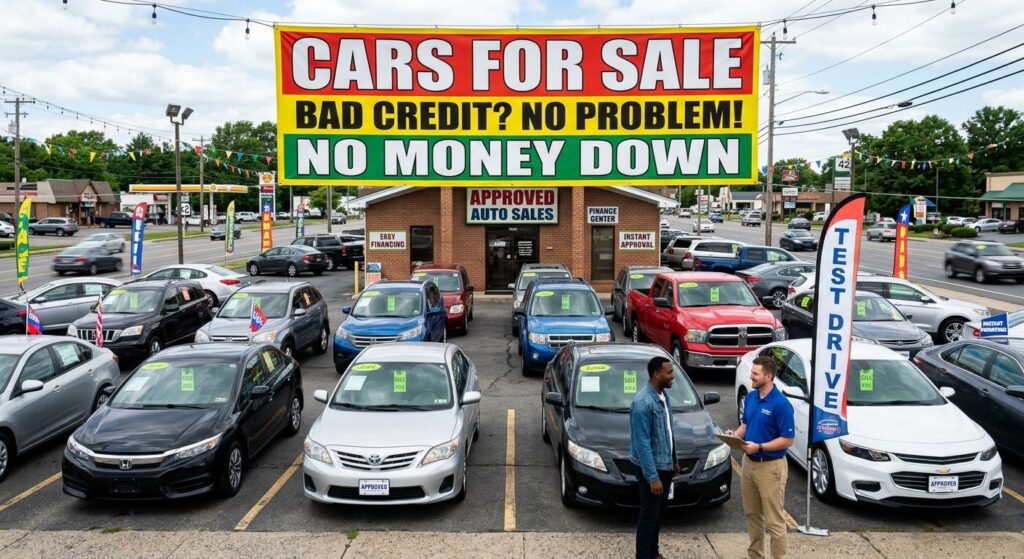
Understanding the Landscape: What Does “Bad Credit No Money Down” Actually Mean?
To make an informed decision, you must first understand the terminology. When you see an advertisement for “cars for sale bad credit no money down,” it is rarely a simple statement of fact. It is a marketing hook designed to attract attention. Let’s break down the components.
Bad Credit generally refers to a FICO score below 620, though some lenders consider anyone below 660 to be “subprime.” A low credit score indicates to lenders that you have a higher risk of defaulting on your loan. This risk is calculated based on your past behavior: late payments, collections, charge-offs, bankruptcies, or repossessions.
No Money Down means you do not need to pay a lump sum upfront before driving off the lot. Traditionally, buyers put down 10% to 20% of the car’s value to reduce the loan amount and monthly payments. With no money down, the entire purchase price (plus taxes and fees) is rolled into the loan. This can lead to being “upside down” or “underwater” on your loan almost immediately, meaning you owe more on the car than it is actually worth.
When combined, “bad credit no money down” implies a lender willing to take a significant risk on you with zero skin in the game from your pocket. This is possible because the interest rates will likely be high, and the terms may be shorter or include additional fees. It is a trade-off: convenience and immediate access to a vehicle versus long-term cost.
Why Do These Options Exist?
You might wonder why dealerships and lenders would offer cars to people with poor credit and no cash. The answer lies in profit margins and risk assessment.
- High Interest Rates: Subprime loans carry significantly higher Annual Percentage Rates (APRs). While a person with excellent credit might get a rate of 4-5%, someone with bad credit could easily see rates between 12% and 20% or even higher. Over the life of a 60-month loan, this difference can amount to thousands of dollars in extra interest.
- Extended Warranties and Add-ons: Dealers love to sell add-ons like gap insurance, extended warranties, and paint protection. These items are highly profitable for the dealer and are often pushed onto buyers with lower credit scores because they are perceived as needing more protection for their investment.
- Shorter Loan Terms: To mitigate risk, lenders may offer shorter loan terms (e.g., 36 months instead of 72). This increases the monthly payment but ensures the loan is paid off faster, reducing the time the lender is exposed to risk.
- Repossession Insurance: Many subprime lenders require borrowers to have full coverage insurance, including gap insurance, which protects the lender if the car is totaled or stolen and the borrower defaults.
Where to Find “Cars for Sale Bad Credit No Money Down”
The market for these vehicles is vast, but it is fragmented across several channels. Knowing where to look can save you hours of frustration and help you avoid scams.
1. Buy Here Pay Here (BHPH) Dealerships
Also known as “repos lots,” BHPH dealerships are the most common source for no-money-down, bad-credit cars. In this model, the dealership acts as both the seller and the lender. They keep the car in their inventory, finance it themselves, and collect the payments directly from you, usually via automatic bank drafts or weekly visits.
Pros:
- Easy Approval: Since they use their own criteria, they are less focused on your credit score and more focused on your ability to pay. Proof of income and residency is often all you need.
- No Money Down: Many offer $0 down options.
- Speed: You can often drive off the lot the same day.
Cons:
- Higher Prices: BHPH lots often charge above-market prices for their vehicles because they bundle the financing risk into the sticker price.
- Lower Quality: The cars are often older models with higher mileage. Maintenance records may be spotty.
- Strict Payment Schedules: Missing a payment by even a day can result in the car being disabled remotely or towed away quickly.
2. Online Marketplaces
Websites like Carvana, Vroom, Shift, and Cars.com aggregate listings from various dealers. You can filter by “bad credit friendly” or “no money down” in many cases. Additionally, Facebook Marketplace and Craigslist are goldmines for private sellers who may be willing to negotiate terms directly.
Pros:
- Variety: Access to a wide range of vehicles from different sellers.
- Transparency: Listings often come with detailed photos, vehicle history reports (Carfax/AutoCheck), and pricing comparisons.
- Convenience: You can shop from home and compare multiple deals.
Cons:
- Financing Variability: Financing is often handled by third-party lenders, so approval isn’t guaranteed until you apply.
- Fees: Online platforms may charge delivery fees, documentation fees, or subscription fees.
3. Traditional Dealerships with Subprime Lenders
Many large dealership chains have partnerships with captive finance companies (like Ford Credit, Toyota Financial Services) and external subprime lenders. Even if your credit is bad, if you buy a certified pre-owned vehicle, you might qualify for better rates than at a BHPH lot.
Pros:
- Better Vehicle Quality: Certified Pre-Owned (CPO) cars come with warranties and rigorous inspections.
- Negotiation: You can negotiate the price of the car separately from the financing terms.
- Reliability: Established brands mean easier access to parts and service.
Cons:
- Stricter Requirements: Even with subprime programs, you may need a minimum credit score or a co-signer.
- Down Payments: Some programs require a small down payment (e.g., $1,000).
4. Private Sellers
Buying from a private party can sometimes bypass traditional financing altogether. You might find a seller willing to accept installment payments directly from you, especially if they know you have bad credit.
Pros:
- Flexibility: Terms are entirely up to you and the seller.
- Lower Prices: No dealer markup or fees.
- Personal Connection: You can build trust with the seller.
Cons:
- Risk: No warranty, no recourse if the car breaks down.
- Paperwork: You handle all the title transfer and registration paperwork yourself.
- Payment Collection: If you miss a payment, you don’t necessarily lose the car unless there is a specific lien structure in place.
The Hidden Costs: Reading Between the Lines
When you see “No Money Down,” it’s easy to get excited. But the devil is in the details. Here are the hidden costs you must watch out for.
1. High Interest Rates (APR)
As mentioned, bad credit equals high interest. A $15,000 car financed at 5% for 60 months results in total payments of approximately $14,280. The same car financed at 15% for 60 months results in total payments of approximately $17,970. That’s nearly $4,000 extra for having bad credit. Always ask for the APR before signing anything.
2. Gap Insurance
If you have no money down, you are immediately upside down on your loan. If you crash the car, the insurance company will pay only the actual cash value (ACV) of the car, which might be less than what you owe. Gap insurance covers the difference. It’s crucial for no-money-down buyers, but it adds $20-$50 per month to your payment. Negotiate whether this is included or optional.
3. Extended Warranties
Dealers will try to sell you an extended warranty for $1,000-$3,000, added to your loan. These are often overpriced and cover things that are already covered by the manufacturer’s limited warranty. Read the fine print to see what is excluded.
4. Documentation and Processing Fees
Dealerships charge “doc fees” ranging from $100 to $500 or more. These are non-negotiable in many states and are pure profit for the dealer. Ask for a breakdown of these fees.
5. Prepayment Penalties
Some subprime loans have prepayment penalties, meaning if you want to pay off the loan early to save on interest, you’ll be charged a fee. Look for “no prepayment penalty” clauses.
How to Qualify for Bad Credit No Money Down Loans
Even with no money down, you still need to prove you’re a good candidate. Here’s what lenders look for:
- Proof of Income: You must show steady employment. Bank statements showing regular deposits are often required. Self-employed individuals may need tax returns.
- Residency: You must live in the area where you’re applying. A stable address shows stability.
- Bank Account: A checking account in your name is usually required for automatic payments.
- Co-Signer: If your credit is very poor, adding a co-signer with good credit can significantly improve your chances and lower your interest rate. The co-signer is equally responsible for the debt.
- Down Payment Alternatives: If you truly have $0, ensure the loan covers all taxes and fees. Sometimes, a small down payment ($500) can secure a much better rate.
Step-by-Step Guide to Buying Your First Bad Credit Car
Step 1: Check Your Credit Report
Know where you stand. Get your free credit report from AnnualCreditReport.com. Dispute any errors. If you have a late payment listed incorrectly, fix it before you start shopping.
Step 2: Determine Your Budget
Use the 20/4/10 rule as a guideline, even if you bend it. Try to keep your car payment under 10% of your monthly gross income. Remember to factor in gas, insurance, maintenance, and registration.
Step 3: Shop Around
Don’t settle for the first deal. Visit three to five dealerships. Compare the total cost of ownership, not just the monthly payment. A lower payment might mean a longer loan term or higher interest rate.
Step 4: Get Pre-Approved
If possible, get pre-approved for a loan from a credit union or online lender. This gives you leverage in negotiations. You know the maximum interest rate you’re willing to accept.
Step 5: Negotiate the Price First
Focus on the “out-the-door” price of the car before discussing financing. If the dealer knows you’re desperate, they might inflate the price and then offer “great financing.” Separate the two negotiations.
Step 6: Review the Contract Carefully
Before signing, read every line. Check for:
- Correct interest rate
- Loan term (number of months)
- Total amount financed
- Monthly payment amount
- Any add-ons you didn’t agree to
- Prepayment penalties
Step 7: Drive Off the Lot
Once everything checks out, sign, drive, and start making payments on time. Set up automatic payments to avoid missing a due date, which could hurt your credit further.
Common Mistakes to Avoid
1. Focusing Only on Monthly Payment
Dealers often say, “I can get you into this car for $299 a month!” But they might stretch the loan to 72 or 84 months. You’ll pay more in total interest and end up owing more for years. Always look at the total cost.
2. Skipping the Inspection
Even if you’re buying from a reputable dealer, have a mechanic inspect the car. A $100 inspection can save you $1,000 in repairs. For private sales, this is essential.
3. Ignoring Insurance Costs
Insurance premiums vary widely by car model. Older cars might have higher deductibles. Make sure you can afford the insurance before buying.
4. Not Having an Emergency Fund
Life happens. If your car breaks down, you still need to make the payment. Keep a small emergency fund for unexpected expenses.
5. Taking the First Offer
Always counter-offer. Dealers expect negotiation. Start 10-15% below their asking price and work from there.
The Role of Technology in Bad Credit Auto Buying
Technology has democratized access to bad credit cars. Apps like Acqurio, Turo, and various fintech lenders now use alternative data points—such as utility bill payments, rent history, and bank account activity—to assess creditworthiness. This means you might qualify for a loan even if your FICO score is low, as long as you show consistent financial responsibility in other areas.
Additionally, virtual showrooms allow you to browse inventory from home, schedule test drives, and even complete paperwork online. This reduces pressure and gives you time to think critically about your decision.
Case Studies: Real-Life Scenarios
Scenario 1: Sarah, the Recent Divorcee
Sarah, 34, went through a difficult divorce. She lost her house and had to move back in with her sister. Her credit score dropped to 550 due to missed mortgage payments during the separation. She needs a car to get to her new job.
Solution: Sarah visited a local BHPH dealership. She brought proof of income (pay stubs) and her lease agreement. She found a 2015 Honda Civic with 80,000 miles for $12,000. With no money down, she financed the full amount plus taxes and fees ($13,500 total) at 14% APR for 60 months. Her payment was $250/month. She bought gap insurance and declined the extended warranty. After six months of on-time payments, her credit score improved to 580, allowing her to refinance at a lower rate next year.
Scenario 2: James, the Young Professional
James, 22, just started his first job after college. He has no credit history (a “thin file”). He wants a reliable car to commute to work.
Solution: James used a credit union that considers bank account history. He opened a checking account and kept a balance for six months to build rapport. He then applied for a loan for a 2018 Toyota Corolla. Because he had no prior debt, the credit union offered him a 7% APR for 48 months. He made a small down payment of $1,000 from his savings, which lowered his monthly payment and showed commitment. He avoided add-ons and drove away happy.
Scenario 3: Maria, the Gig Worker
Maria, 40, works as a freelance graphic designer. Her income fluctuates, and she has a collection account on her credit report from a medical bill. She needs a car for client meetings.
Solution: Maria used an online lender that accepts gig workers. She provided her bank statements showing consistent deposits over the last year. She found a used Ford Escape on a marketplace site. The seller agreed to a private installment plan, but Maria preferred a formal loan for credibility. She got pre-approved online, then negotiated with the dealer. She secured a 10% APR loan for 60 months. She paid for gap insurance but skipped the extended warranty. She set up automatic payments to ensure consistency.
Tips for Rebuilding Your Credit Through Auto Financing
Your car loan can be a powerful tool for rebuilding credit if managed correctly. Here’s how:
- Pay On Time, Every Time: Payment history makes up 35% of your FICO score. One missed payment can drop your score by 50-100 points. Set up reminders.
- Keep Utilization Low: If you have other credit cards, keep balances below 30% of your limit.
- Diversify Credit Mix: Having a mix of credit types (installment loans and revolving credit) helps your score. An auto loan adds an installment loan to your profile.
- Monitor Your Score: Use free services like Credit Karma or Experian to track your progress. Celebrate milestones.
- Refinance When Possible: Once your score improves, refinance your auto loan to a lower rate. This saves money and shows lenders you’re a responsible borrower.
The Future of Bad Credit Auto Financing
The future looks brighter for bad credit borrowers. As more lenders adopt AI and machine learning, underwriting becomes more nuanced. Instead of relying solely on credit scores, lenders will look at holistic financial behaviors. This means more people will have access to fairer rates.
Additionally, the rise of electric vehicles (EVs) and used EVs creates new opportunities. Used EVs are becoming more affordable, and some manufacturers offer special financing programs for buyers with lower credit scores to promote adoption.
Conclusion
” Cars for sale bad credit no money down” is not just a slogan; it’s a viable path to mobility and financial recovery. By understanding the pros and cons, knowing where to look, and avoiding common pitfalls, you can secure a reliable vehicle that fits your budget. Remember, the goal isn’t just to get a car—it’s to get a car that helps you build a better financial future. Take your time, do your homework, and drive with confidence.
Disclaimer: The information provided in this article is for educational purposes only and does not constitute financial, legal, or investment advice. Auto financing terms, interest rates, and regulations vary by region, lender, and individual circumstances. Always read the fine print of any loan agreement, consult with a qualified financial advisor, and verify current market conditions before making a purchasing decision. The author and publisher are not responsible for any losses or damages incurred from the use of this information.