
Finding the right car loan rates can help you manage the cost of buying a vehicle. Whether you are shopping for a new car, purchasing a used vehicle, or replacing an existing auto loan, understanding how interest rates work can help you make a more informed financial decision.
Car loan rates in the United States vary among lenders and borrowers. Your credit history, income, loan amount, repayment term, vehicle type, and current market conditions may influence the rate you receive.
However, the lowest advertised interest rate is not always the best financing option. It is important to compare annual percentage rates (APRs), monthly payments, fees, and total repayment costs before signing a loan agreement.
This guide explains what affects car loan rates, how to compare financing offers, and what you can do to prepare for an affordable auto loan.
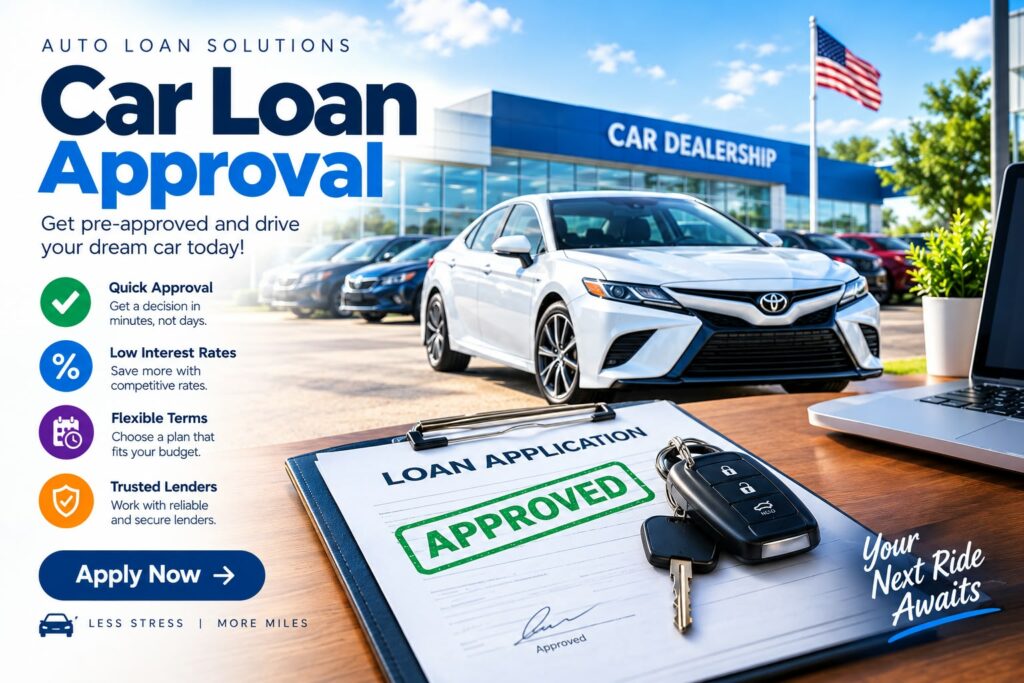
What Are Car Loan Rates?
Car loan rates represent the interest charged when you borrow money to purchase a vehicle. The rate determines how much interest accumulates on the outstanding loan balance over the repayment period.
Most traditional auto loans are repaid through regular installments that include principal and interest. The principal is the amount borrowed, while interest is the cost of borrowing that money.
For example, if you finance a vehicle through a lender, your monthly payment will generally depend on the amount financed, interest rate, and length of the loan.
A higher interest rate usually increases the total cost of borrowing when other loan conditions remain the same. A lower rate can reduce interest expenses, making the loan less expensive overall.
Before comparing offers, understand the difference between an interest rate and an annual percentage rate. The APR generally reflects the annual cost of credit and may include certain additional borrowing charges.
What Determines Your Car Loan Rate?
Lenders evaluate several factors when deciding which rates and financing terms to offer applicants. Understanding these factors can help you prepare before applying.
Credit Score and Credit History
Your credit profile can play an important role in determining your car loan rate. Lenders may review your credit score, payment history, existing accounts, outstanding balances, and previous borrowing behavior.
Borrowers with stronger credit profiles may qualify for more competitive rates. Applicants with limited credit histories or previous payment problems may receive higher rates or face additional eligibility requirements.
There is no universal credit score that guarantees a specific interest rate. Each lender uses its own underwriting criteria.
Before applying for financing, review your credit reports for inaccurate information. If you identify an error, contact the relevant credit reporting agency to dispute it.
Loan Amount
The amount you borrow affects your monthly payment and total interest costs.
A larger loan generally results in higher payments when the interest rate and repayment term remain unchanged. Reducing the amount financed through a down payment or a less expensive vehicle may help make the loan more manageable.
When calculating your financing needs, consider the vehicle’s purchase price, taxes, registration charges, dealer fees, and any trade-in value.
Repayment Term
The repayment term is the amount of time allowed to pay off the loan. Common auto loan terms include 36, 48, 60, and 72 months, although other options may be available.
A longer repayment term can reduce the required monthly payment. However, it may increase the total interest paid over the life of the loan.
A shorter term usually requires higher monthly payments but can reduce total interest expenses when the other loan conditions are comparable.
Choose a term that balances monthly affordability with the total cost of financing.
Vehicle Age and Condition
Car loan rates and eligibility may differ between new and used vehicles.
Some lenders offer promotional financing on selected new cars to qualified applicants. Used vehicles may have different rates depending on their age, mileage, condition, and market value.
Before financing a used vehicle, consider its maintenance history and expected repair costs. A lower purchase price may not necessarily mean lower overall ownership expenses.
Income and Existing Debt
Lenders may evaluate your income, employment information, and existing debt obligations to determine whether you can manage the proposed payments.
Your debt-to-income ratio compares monthly debt payments with gross monthly income. Some lenders use this measure as part of their application assessment.
Selecting a vehicle within your budget and managing existing debts responsibly can help you prepare for a financing application.
Car Loan Rates for New vs. Used Vehicles
New and used car financing may involve different rates, eligibility requirements, and loan conditions.
New Car Loan Rates
Some manufacturers and dealerships offer promotional financing on new vehicles. These offers may feature attractive rates for applicants who meet specific credit and eligibility requirements.
Promotional offers can have conditions, including restrictions on the vehicle model, loan term, or available discounts.
Compare the financing offer with other available options. A low promotional rate may not automatically provide the lowest total purchase cost if another deal includes a larger vehicle discount.
Used Car Loan Rates
Used car financing may have different rates and restrictions depending on the lender and the vehicle.
Factors such as age, mileage, condition, and purchase price can affect available loan products. Some lenders may restrict financing for older vehicles or vehicles above certain mileage limits.
Compare multiple lenders and consider the total ownership cost before purchasing a used car.
Which Option Is More Affordable?
Neither new nor used car financing is always cheaper. The answer depends on the purchase price, interest rate, loan term, discounts, and ongoing expenses.
Calculate the expected total cost of each option rather than choosing solely on the basis of the monthly payment.
How to Calculate Your Monthly Car Loan Payment
Your monthly car loan payment depends mainly on the amount financed, interest rate, and repayment term.
For a standard fixed-rate loan with monthly payments, the payment can be calculated using the following formula:
Monthly payment = (P \times \frac{r(1+r)^n}{(1+r)^n-1})
Where:
- P is the amount borrowed.
- r is the monthly interest rate expressed as a decimal.
- n is the total number of monthly payments.
For example, suppose you borrow $20,000 at a fixed annual interest rate of 6.5% for 60 months.
Under standard monthly amortization assumptions, the estimated payment would be approximately $391 per month. The total of the 60 payments would be about $23,460, including approximately $3,460 in interest.
This example excludes additional fees, taxes, insurance, and other vehicle ownership expenses. It is an illustration, not a current market-rate quote or a guaranteed financing offer.
Comparing several rates and loan terms can help you understand how much your monthly payment and total interest may change.
How to Compare Car Loan Rates From Different Lenders
Comparing financing offers can help you identify a loan that fits your financial circumstances.
Compare the APR
Review the APR rather than looking only at the advertised interest rate. The APR generally includes the interest rate and certain other credit costs.
Make sure the loan amount and repayment term are comparable across offers. Different terms can produce different monthly payments even when the interest rates are similar.
Review Total Repayment Costs
Calculate the total amount you would pay over the complete loan term.
A loan with a lower monthly payment may cost more overall if it extends the repayment period. Consider the principal, total interest, and applicable fees before choosing an offer.
Compare Banks, Credit Unions, and Online Lenders
Different financing providers may offer different rates and eligibility requirements.
Consider requesting quotes from banks, credit unions, reputable online lenders, and dealership financing departments.
Compare written offers carefully and confirm that the quoted terms apply to your circumstances and the vehicle you intend to purchase.
Check Fees and Contract Conditions
Review the financing agreement for documentation fees, late payment charges, prepayment conditions, and optional products.
Ask the lender to explain any terms you do not understand. Make sure the final agreement matches the offer you accepted.
How to Qualify for Better Car Loan Rates
Although no action guarantees a lower rate, several steps may help you improve your financing options.
Review Your Credit Reports
Check your credit reports before applying. Correct inaccurate information through the appropriate credit reporting agency.
Paying bills on time and managing outstanding balances responsibly may support your credit profile over time. Improvements are not immediate or guaranteed.
Make a Larger Down Payment
A larger down payment reduces the amount you need to borrow. This can reduce the monthly payment and total interest paid when other loan terms remain unchanged.
However, avoid using all your savings for the down payment. Retaining emergency funds can help protect you against unexpected expenses.
Get Preapproved Before Visiting a Dealership
A preapproval may provide an estimate of the loan amount and terms available to you.
It can also help you compare dealership financing with offers from independent lenders. Remember that preapproval is not always a final loan commitment.
Confirm the final APR, fees, and eligibility conditions before signing.
Choose an Affordable Vehicle
Borrowing less can reduce your financing costs, even if the interest rate does not change.
Consider the complete cost of owning the vehicle, including fuel, insurance, maintenance, registration, and repairs. A less expensive car may allow you to keep your monthly financial obligations under control.
Compare Offers Within a Short Shopping Period
When shopping for auto financing, you may wish to submit applications to multiple lenders within a relatively short period.
Depending on the credit scoring model, qualifying auto loan inquiries made within a specified shopping window may be grouped together for scoring purposes. The applicable window varies by model.
Ask lenders whether they use soft or hard credit inquiries during prequalification and formal applications.
Can You Negotiate Car Loan Rates?
In some circumstances, you may be able to obtain better financing terms by comparing offers and asking lenders whether they can improve their terms.
Start by collecting quotes from multiple providers. Review the APR, repayment period, fees, and total cost of each offer.
If you receive a competitive offer from a bank or credit union, you can ask the dealership whether it can provide comparable or better financing.
Focus on the entire transaction. A lower rate may not be the best deal if the vehicle price is higher or the agreement includes costly add-ons.
Always review the final written agreement before accepting the financing.
Should You Refinance Your Car Loan?
Refinancing replaces your existing auto loan with a new loan. It may be worth considering if you qualify for a lower APR or need to adjust your repayment structure.
Potential benefits include reduced monthly payments or lower total interest costs. However, the outcome depends on the new loan’s rate, fees, and term.
Extending the repayment period may lower your monthly payment while increasing the total interest you pay. You should also consider the remaining balance, vehicle value, and any charges associated with replacing the loan.
Calculate the potential savings before refinancing and confirm that the new agreement offers a meaningful financial benefit.
Common Mistakes to Avoid When Shopping for Car Loan Rates
Avoid these common financing mistakes:
- Choosing only by monthly payment: A low payment may reflect a longer loan term.
- Ignoring the APR: The interest rate alone may not show all relevant borrowing costs.
- Accepting the first offer: Comparing several reputable lenders may reveal better terms.
- Borrowing too much: A large loan can put unnecessary pressure on your budget.
- Overlooking fees: Documentation charges and optional products can increase the total cost.
- Ignoring depreciation: Your car may lose value faster than you repay the loan.
- Skipping the contract review: Understand all payment requirements and applicable penalties before signing.
A careful comparison can help you make a more informed decision and avoid unnecessary borrowing costs.
Frequently Asked Questions About Car Loan Rates
What is a good car loan rate?
A competitive rate depends on current market conditions, your credit profile, vehicle type, repayment term, and lender requirements. Compare recent offers for similar financing arrangements rather than relying on one universal benchmark.
Do car loan rates depend on credit scores?
Yes, credit scores and broader credit histories can influence the rates lenders offer. However, each lender evaluates applications differently, and a particular score does not guarantee a specific rate.
Are used car loan rates higher than new car loan rates?
They can be, but this is not always the case. Lenders use different pricing policies, and promotional new-car financing may be available to qualified applicants.
Can I get a car loan with a low credit score?
Some lenders consider borrowers with lower credit scores or limited credit histories. These loans may have higher rates or additional conditions. Compare the total cost carefully before accepting an offer.
Does a larger down payment lower my car loan rate?
A larger down payment reduces the amount borrowed and generally lowers total interest costs if the other loan terms remain unchanged. Whether it reduces the actual interest rate depends on the lender’s criteria.
Can I pay off my car loan early?
Some auto loans allow early repayment, but contract conditions vary. Review your agreement and check whether any prepayment penalties apply before paying off the loan.
How can I check current car loan rates?
Check recent rate information from reputable financial institutions, credit unions, and official lender websites. For an accurate estimate, request a personalized quote and review the final APR and loan terms.
Final Thoughts
Car loan rates are an important factor when deciding how to finance a vehicle. Your credit history, loan amount, repayment term, vehicle type, and lender choice can all influence the cost of borrowing.
Before committing to a loan, compare several offers, calculate your total repayment costs, and review the complete financing agreement. Make sure the monthly payment fits your budget while leaving room for insurance, maintenance, and other essential expenses.
The best car loan is not necessarily the one with the lowest advertised rate. It is the option that provides suitable terms and a manageable total cost for your financial situation.
Disclaimer: This article is for educational purposes only and does not constitute financial, legal, or tax advice. Car loan rates, eligibility requirements, and financing terms vary by lender, borrower, vehicle, and market conditions. Verify current offers directly with lenders before making a financial decision.