
Ualifies, and When to Take the Leap
In the world of automotive financing, few phrases are as seductive—and potentially lucrative—as “0% interest.” For millions of car buyers, this promise represents the holy grail of saving money on a monthly payment. It suggests that you can drive off the lot without paying a single cent in extra costs for borrowing money. However, like many things in finance, 0% interest car deals are not exactly what they seem at first glance. They are powerful tools, but they come with specific conditions, hidden trade-offs, and eligibility requirements that can turn a great deal into a mediocre one if you aren’t careful.
This article dives deep into the mechanics of zero-percent auto loans, helping you understand when these offers make sense, who qualifies for them, and how to navigate the fine print so you can maximize your savings.
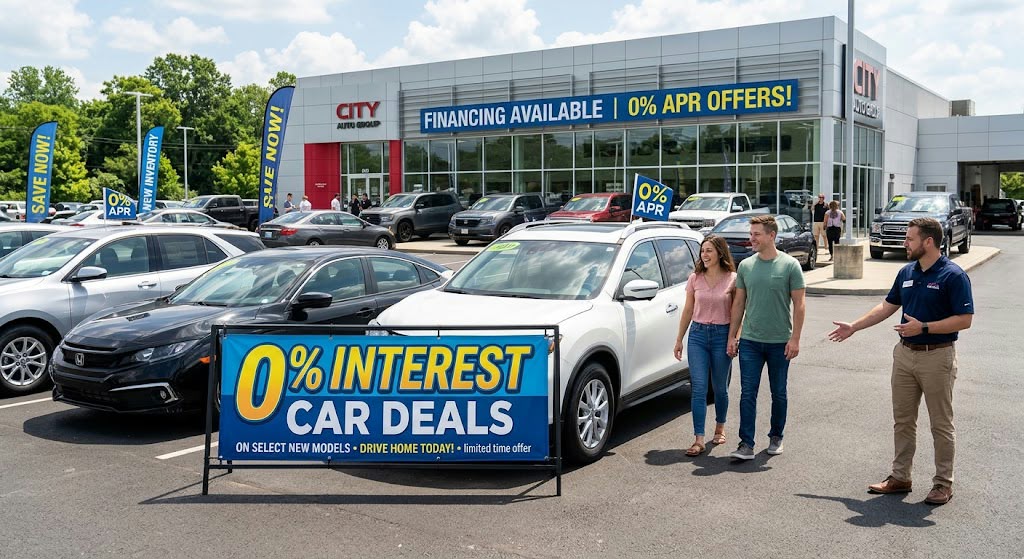
What Exactly Is a 0% Interest Auto Loan?
At its core, a 0% interest auto loan is a financing arrangement where the lender charges no interest on the borrowed amount. If you borrow $30,000 for three years, you pay back exactly $30,000. No additional dollars are added for the privilege of borrowing. This stands in stark contrast to standard auto loans, which typically carry an Annual Percentage Rate (APR) ranging from 4% to 10% or higher, depending on your credit score and market conditions.
It is crucial to distinguish between “0% APR” and “0% down payment.” Many people confuse the two. A 0% down payment means you finance the entire price of the car (plus taxes and fees), whereas 0% interest refers specifically to the cost of borrowing. You can have a 0% down payment with a high-interest rate, or a substantial down payment with a 0% interest rate. Understanding this distinction is vital before signing any paperwork.
Why Do Dealerships Offer 0% Interest?
You might wonder why a dealership or manufacturer would give away free money. The answer lies in marketing strategy and inventory management. Manufacturers use 0% financing as a promotional tool to move metal, especially during end-of-model-year clearances or when launching new vehicles. By offering low or zero interest rates, they can often charge more for the vehicle itself because the lower monthly payment makes the car appear more affordable than it actually is.
Furthermore, 0% financing allows manufacturers to subsidize the interest themselves rather than relying on third-party banks. They calculate the cost of the forgone interest and factor it into the overall profitability of the sale. Essentially, you are trading potential interest savings for the ability to buy a car at full MSRP (Manufacturer’s Suggested Retail Price) rather than negotiating a discount on the car’s price.
The Catch: The Trade-Off Between Price and Payment
The most significant trade-off in a 0% interest deal is the loss of cash rebates. This is the golden rule of auto financing: you usually cannot stack 0% financing with a manufacturer rebate.
Let’s look at a concrete example. Imagine you are buying a $30,000 sedan.
- Scenario A (0% Interest): You get 0% financing, but you must pay the full $30,000. Over a 60-month term, your monthly payment is $500. Total paid: $30,000.
- Scenario B (Standard Financing + Rebate): You qualify for a $2,000 cash rebate, bringing the price to $28,000. However, you must take out a loan at 5% interest over 60 months. Your monthly payment is approximately $529. Total paid: $31,740.
In Scenario A, you pay less total money ($30,000 vs. $31,740). However, Scenario B gives you $2,000 cash upfront. While Scenario A saves you money in the long run, Scenario B improves your immediate cash flow. Additionally, if you plan to sell the car or trade it in early, the equity dynamics change. In Scenario A, you have built up less equity initially compared to the discounted principal in Scenario B, though the total debt is lower.
Always run the numbers. Calculate the total cost of the loan, including interest, and compare it to the total cost of the rebate option. Often, the 0% deal wins on total cost, but the rebate wins on monthly affordability.
Who Qualifies for 0% Interest?
Not everyone gets the same offer. Manufacturers reserve their best 0% deals for borrowers with excellent credit. Typically, you need a FICO score of 750 or higher to qualify for the lowest rates, including 0%. If your credit score drops slightly, you might be offered 1.9%, 2.9%, or 3.9%, which are still good rates but not “free.”
Dealers also look at your employment history and debt-to-income ratio. Even with perfect credit, if you have a high debt load relative to your income, you might be denied the top-tier offer. Additionally, 0% offers are often restricted to specific models. You won’t find 0% financing on rare, high-demand luxury cars or trucks with limited inventory. These offers are typically targeted at vehicles that are struggling to sell or are about to be replaced by a new model year.
Short-Term vs. Long-Term: The Term Trap
Another subtle trap in 0% interest deals is the loan term. Manufacturers often limit 0% financing to shorter terms, such as 36 or 48 months. Longer terms, like 72 or 84 months, might only be available at higher interest rates.
Why does this matter? Shorter terms mean higher monthly payments. If you stretch a $30,000 loan over 36 months at 0%, your payment is $833. Over 60 months, it’s $500. If your budget can only handle $500, you might think 0% isn’t for you. But remember, the total cost is the same. The question is whether your monthly cash flow can accommodate the higher payment required to keep the interest at zero.
Conversely, some lenders offer 0% financing over longer terms (up to 72 months). This is rare but incredibly beneficial if it exists, as it lowers your monthly burden while keeping the total cost low. Always check the maximum term eligible for the 0% offer.
Negotiating with 0% Financing
A common misconception is that you should negotiate the car price separately from the financing. In reality, when you choose 0% financing, you are effectively agreeing to a fixed price because you forfeit the cash rebate. Therefore, your negotiation power shifts.
Instead of asking for a discount off MSRP, focus on getting the best possible 0% deal. Ensure there are no hidden fees, such as documentation fees or dealer add-ons, that inflate the principal amount. Since you aren’t paying interest, every dollar added to the principal is a dollar you lose. Negotiate the “out-the-door” price aggressively, then apply the 0% financing to that final number.
If the dealer tries to pressure you into a 0% deal without explaining the lost rebate, ask them to show you the math side-by-side. Sometimes, the rebate option is actually cheaper if you plan to pay off the car early or if you have the cash to invest elsewhere at a higher rate than the implicit interest rate of the loan.
Alternatives to 0% Interest
If you don’t qualify for 0% financing due to a lower credit score, don’t despair. There are other strategies to save money.
- Low-Interest Loans: Rates of 2-3% are often still better than the national average. Compare offers from credit unions, which frequently offer lower rates than big banks.
- Cash Back Rebates: If you have a strong credit profile, taking the cash rebate and paying off the loan early can be smarter than 0% financing. Use the saved cash to pay down high-interest debt or invest it.
- Subsidized Financing: Some manufacturers offer subsidized rates for military members, recent graduates, or first-time buyers. These can sometimes be combined with partial rebates.
When Should You Choose 0% Interest?
You should choose a 0% interest car deal when:
- You have excellent credit (750+ FICO).
- You plan to keep the car for the full term of the loan.
- The monthly payment fits comfortably within your budget, even if it’s higher than a rebate-based loan.
- The cash rebate offered is less than the interest you would save over the life of the loan.
- You don’t need the liquidity of the cash rebate for other investments or emergencies.
When Should You Avoid It?
Avoid 0% financing when:
- You plan to trade in the car after just two or three years. With 0% financing, you build equity slower initially because a larger portion of your early payments goes toward principal rather than interest (though technically all payments go to principal, the balance remains higher compared to a discounted loan).
- You can invest the difference between the rebate and the loan cost at a higher return than the implicit interest rate.
- The monthly payment is too high for your current cash flow, causing financial strain.
- The 0% offer comes with a significantly higher vehicle price or excludes valuable features.
Conclusion
0% interest car deals are a fantastic opportunity for financially savvy buyers with strong credit. They offer true savings and simplify the math of car buying. However, they are not always the best option for everyone. By understanding the trade-offs between price, payment, and rebates, and by doing the hard numbers before walking onto the lot, you can ensure that you’re making the smartest choice for your wallet. Remember, the cheapest monthly payment isn’t always the cheapest car. Look at the total cost, consider your long-term plans, and never sign until you’ve verified the numbers yourself.
Disclaimer: The information provided in this article is for educational purposes only and does not constitute financial, legal, or investment advice. Auto loan terms, interest rates, and availability vary by lender, region, and time. Past performance of interest rates does not guarantee future results. Always read the fine print of any loan agreement, verify current rates with multiple lenders, and consult with a qualified financial advisor before making major financial decisions. The examples provided are illustrative and may not reflect actual market conditions or specific loan offers available to you.