
Buying a car is often one of the most significant financial decisions an individual makes in their lifetime, second only perhaps to purchasing a home. It is a purchase that blends emotion with logic, desire with necessity. However, the excitement of driving off the lot can quickly turn into anxiety if the financing isn’t managed correctly. This is where the car loan repayment calculator becomes an indispensable tool. It is not merely a digital device for crunching numbers; it is a strategic instrument that allows buyers to visualize their future, understand the true cost of borrowing, and make informed decisions that align with their long-term financial health.
In this comprehensive guide, we will delve deep into the mechanics of car loan repayments, explore how calculators work, analyze the factors that influence your monthly payments, and provide actionable strategies to minimize interest and maximize savings. Whether you are a first-time buyer or a seasoned driver looking to refinance, understanding the intricacies of loan amortization is crucial.
The Anatomy of a Car Loan
Before diving into the calculator itself, it is essential to understand the components that go into a car loan. A car loan is essentially a sum of money borrowed from a lender—such as a bank, credit union, or dealership—to purchase a vehicle. You agree to pay back this amount over a set period, usually ranging from 36 to 84 months, along with interest.
The primary components include:
- Principal: The actual amount of money you borrow to buy the car. This is the base figure upon which interest is calculated.
- Interest Rate (APR): The cost of borrowing money, expressed as a percentage. The Annual Percentage Rate (APR) includes both the interest rate and any fees associated with the loan, giving you a more accurate picture of the total cost.
- Down Payment: An upfront payment made at the time of purchase. A larger down payment reduces the principal amount, thereby lowering your monthly payments and the total interest paid over the life of the loan.
- Loan Term: The duration over which you will repay the loan. Common terms are 36, 48, 60, 72, or even 84 months. Longer terms result in lower monthly payments but higher total interest costs.
- Monthly Payment: The fixed amount you pay each month to gradually pay off the principal and interest.
How a Car Loan Repayment Calculator Works
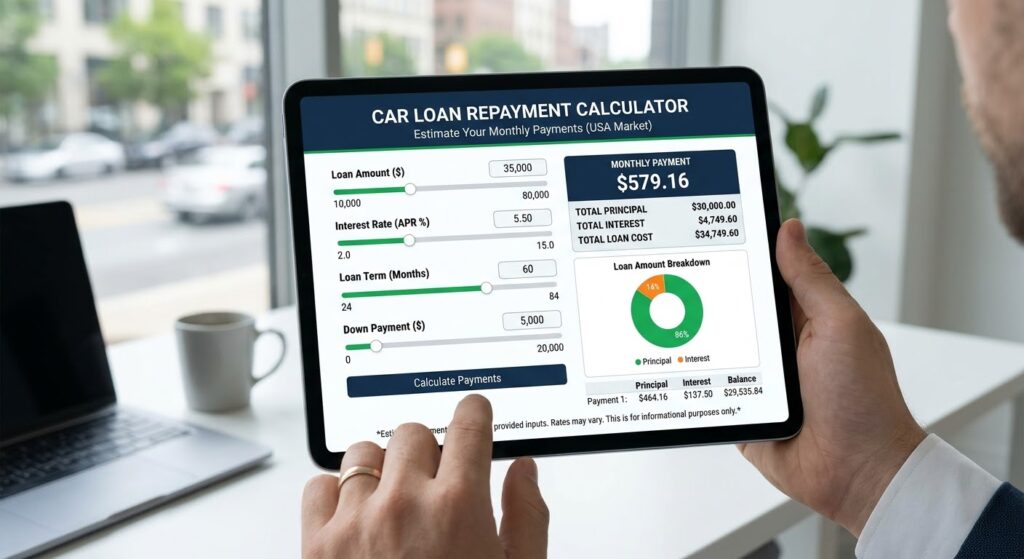
A car loan repayment calculator simplifies the complex mathematics of amortization into an easy-to-understand format. At its core, it uses a standard formula to determine your monthly payment based on the principal, interest rate, and loan term.
The basic formula used by most calculators is derived from the annuity formula:
$$ M = P \frac{r(1+r)^n}{(1+r)^n – 1} $$
Where:
- M is your monthly payment.
- P is the principal loan amount.
- r is the monthly interest rate (annual rate divided by 12).
- n is the number of payments (loan term in months).
While you don’t need to memorize this formula to use a calculator, understanding it helps you grasp why small changes in interest rates or loan terms can have massive impacts on your wallet. For instance, because the interest rate is raised to the power of n, compounding plays a significant role. This means that early in the loan term, a larger portion of your monthly payment goes toward interest rather than reducing the principal. As the loan progresses, this ratio shifts, and more of your payment chips away at the principal balance.
Key Factors Influencing Your Repayment
When using a car loan repayment calculator, several variables can drastically alter the outcome. Understanding these factors empowers you to negotiate better terms and avoid common pitfalls.
1. Credit Score and Interest Rates
Your credit score is arguably the most critical factor in determining the interest rate you will be offered. Lenders view borrowers with high credit scores as low-risk, rewarding them with lower interest rates. Conversely, those with poor credit may face higher rates, sometimes double or triple what a prime borrower pays.
For example, consider a $30,000 car loan over 60 months. If you have excellent credit and secure a 4% APR, your monthly payment might be around $552. However, if your credit is fair and you get a 7% APR, your payment jumps to approximately $592. Over five years, that seemingly small difference results in paying nearly $2,400 more in interest. Using a calculator allows you to see these scenarios side-by-side, helping you decide if improving your credit score before applying is worth the effort.
2. Down Payment Impact
The size of your down payment directly affects the principal amount. A larger down payment means less money borrowed, which leads to lower monthly payments and less total interest. Additionally, a substantial down payment can help you avoid being “upside-down” on your loan, a situation where you owe more on the car than it is actually worth. This is particularly important in the early years of a loan when depreciation hits hardest.
Many financial experts recommend a down payment of at least 20% for new cars and 10% for used cars. By adjusting the down payment field in your car loan repayment calculator, you can experiment with different percentages to find a sweet spot that balances your immediate cash flow with long-term savings.
3. Loan Term Length
There is a direct trade-off between monthly affordability and total cost when choosing a loan term. Longer terms, such as 72 or 84 months, reduce your monthly payment significantly, making the car seem more affordable. However, they also extend the period during which you pay interest, often resulting in a much higher total cost.
Furthermore, longer loan terms increase the risk of negative equity. Since cars depreciate rapidly in the first few years, a 72-month loan might leave you owing thousands more than the car’s value after just three years. If you want to sell or trade in the car before the loan is paid off, you could end up having to pay the difference out of pocket. Use the calculator to compare a 60-month loan versus an 84-month loan to see exactly how much extra interest you are paying for that monthly relief.
4. Taxes, Fees, and Trade-In Value
Some advanced car loan repayment calculators allow you to include sales tax, registration fees, and documentation fees in the loan amount. These costs are often rolled into the principal, meaning you pay interest on them too. Similarly, if you are trading in an old car, its value can be applied as a down payment, reducing the new loan amount. Including these details in your calculation provides a more realistic estimate of your true monthly obligation.
Step-by-Step Guide to Using a Car Loan Repayment Calculator
To get the most out of a car loan repayment calculator, follow these steps:
- Determine Your Budget: Look at your monthly income and expenses to determine how much you can comfortably afford for a car payment without stretching your finances too thin. A general rule of thumb is that your total transportation costs (payment, insurance, fuel, maintenance) should not exceed 15-20% of your take-home pay.
- Check Your Credit Score: Know your starting point. This will help you estimate the interest rate you might qualify for. You can check your score for free through various online services.
- Choose a Target Vehicle: Decide on the price of the car you want to buy. Consider both new and used options, keeping in mind that new cars come with warranties but depreciate faster, while used cars offer better value but may require more maintenance.
- Input the Variables: Enter the vehicle price, your intended down payment, the estimated interest rate, and the desired loan term into the calculator.
- Analyze the Results: Look at the monthly payment, total interest paid, and total cost of the loan. Adjust the variables to see how different scenarios affect the outcome. For example, try increasing your down payment by $1,000 or shortening the loan term by 12 months.
- Compare Offers: Once you have a target number, shop around with multiple lenders. Use the calculator to compare their offers side-by-side. Remember to look at the APR, not just the monthly payment, as some lenders may offer low payments with long terms and high interest rates.
Advanced Strategies for Minimizing Costs
Once you understand the basics, you can employ advanced strategies to save even more money.
Bi-Weekly Payments
Instead of making one monthly payment, some people choose to make half-payments every two weeks. Since there are 52 weeks in a year, this results in 26 half-payments, which equals 13 full monthly payments. This extra payment goes directly toward reducing the principal, shortening the loan term and saving thousands in interest. Many car loan repayment calculators allow you to input bi-weekly payment frequencies to visualize these savings.
Extra Principal Payments
If you receive a bonus, tax refund, or windfall, consider applying it directly to the principal of your car loan. Even small additional payments can significantly reduce the total interest paid and shorten the loan term. Use the calculator to see how much interest you would save by making an extra $100 or $200 payment each month.
Refinancing
If interest rates drop or your credit score improves significantly after taking out your loan, refinancing can be a smart move. Refinancing involves taking out a new loan with better terms to pay off the existing one. This can lower your monthly payment or reduce the total interest paid. However, be aware of any prepayment penalties or refinancing fees that might offset the savings. Always run the numbers through a calculator to ensure refinancing makes financial sense.
Common Mistakes to Avoid
Even with a car loan repayment calculator, buyers can fall into traps. Here are some common mistakes to watch out for:
- Focusing Only on Monthly Payment: Dealerships often advertise low monthly payments to attract buyers. However, a low payment might mean a longer loan term with a higher total cost. Always look at the total price and total interest.
- Rolling Negative Equity into the New Loan: If you owe more on your current car than it’s worth, and you roll that debt into your new loan, you start the new loan upside-down. This can lead to a cycle of debt if you trade in again before paying off the equity.
- Ignoring Insurance Costs: Insurance premiums vary widely depending on the type of car. Luxury or sports cars often cost more to insure. Factor this into your overall budget, not just the loan payment.
- Overextending on Add-Ons: Extended warranties, gap insurance, and tire protection plans can add thousands to the loan amount. While some are useful, others are often overpriced. Calculate whether the added cost is justified by the potential savings.
The Role of Technology in Modern Car Buying
Today’s car loan repayment calculators are more sophisticated than ever. Many are integrated into dealership websites and banking apps, providing real-time estimates based on live interest rates. Some advanced calculators even account for inflation, allowing you to see the “real” value of your payments in today’s dollars. Others offer visual graphs showing the amortization schedule, highlighting how the principal and interest portions of your payment shift over time.
Mobile apps allow you to calculate loans on the go, enabling you to compare offers instantly at the dealership. This technological integration gives buyers more power and transparency in a market that has historically been opaque. By leveraging these tools, you can enter negotiations with confidence, armed with data-driven insights.
Conclusion
The car loan repayment calculator is more than just a utility; it is a key to financial empowerment. By understanding how interest, terms, and down payments interact, you can make smarter choices that save you thousands of dollars over the life of the loan. Whether you are buying a brand-new sedan or a reliable used hatchback, taking the time to crunch the numbers ensures that your car purchase supports your financial goals rather than hindering them.
Remember, the lowest monthly payment is not always the best deal. Look at the big picture, consider your long-term financial health, and use the calculator as your compass. With careful planning and informed decision-making, you can drive away in your dream car knowing that you secured a deal that works for your wallet. In a world of rising interest rates and fluctuating car prices, mastering the art of loan repayment calculation is an essential skill for any modern consumer. Don’t leave money on the table—do the math, plan ahead, and drive with confidence.
Disclaimer: The information provided in this article is for educational and informational purposes only and does not constitute financial advice. Car loan repayment calculations are estimates based on standard formulas and may vary depending on specific lender requirements, fees, taxes, and other factors. Interest rates, loan terms, and payment schedules can change frequently. Always consult with a qualified financial advisor or lender before making final decisions regarding your car loan. Past performance or hypothetical examples do not guarantee future results.