
Owning a car is often seen as a rite of passage into adulthood and financial independence. It represents freedom, flexibility, and the ability to explore the world on your own terms. However, for many people, the upfront cost of purchasing a vehicle can be a significant barrier. Traditional financing often requires a substantial down payment—typically 10% to 20% of the vehicle’s value—to secure a loan with favorable interest rates. This requirement can keep aspiring drivers on the sidelines, waiting until they have saved enough cash to make a down payment before they can even begin shopping for a car.
Enter the concept of “no cash down cars.” This financing option has gained immense popularity in recent years because it addresses one of the biggest hurdles in car buying: liquidity. By allowing buyers to drive away in a new or used vehicle without paying a lump sum upfront, no cash down options open the door to millions of consumers who might otherwise be unable to afford a car. But while the appeal is undeniable, understanding the mechanics, pros, cons, and hidden costs of these deals is crucial to making an informed decision. This article provides a comprehensive deep dive into the world of no cash down car purchases, exploring how they work, who they are best suited for, and what you need to watch out for to avoid financial pitfalls.
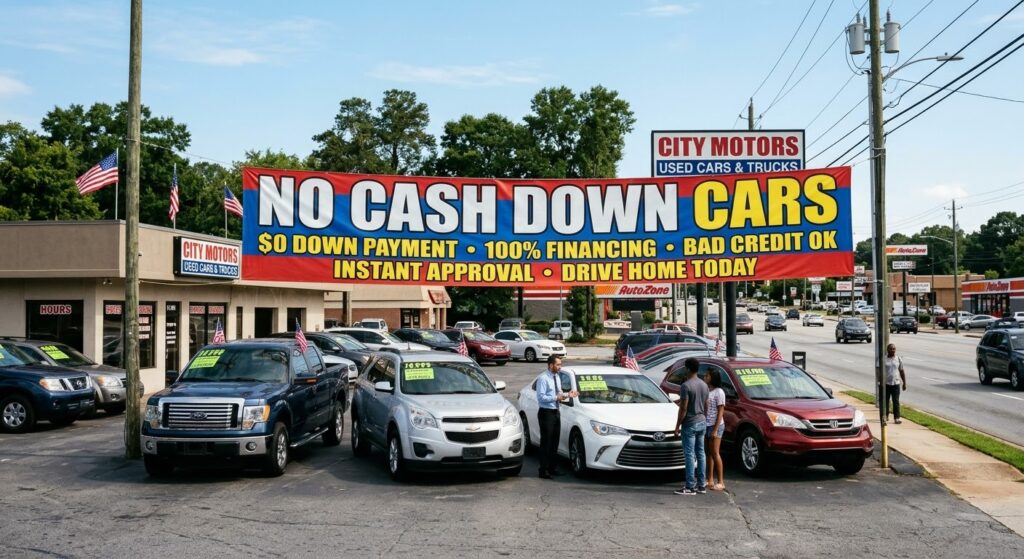
What Exactly Are No Cash Down Cars?
At its core, a no cash down car purchase means that you do not have to pay any money out of pocket at the time of signing the contract. In traditional auto loans, lenders often require a down payment to reduce their risk. A down payment shows the lender that you have “skin in the game” and reduces the total amount you need to borrow. With a no cash down deal, the entire purchase price of the vehicle is financed (plus taxes, registration, and fees), meaning your monthly payments will cover the full cost of the car from day one.
It is important to distinguish between “zero down payment” and “zero out-of-pocket costs.” While you may not pay cash for the down payment, you will still likely have other costs associated with the transaction. These include sales tax, title fees, registration fees, and possibly documentation fees charged by the dealership. Some dealerships roll these costs into the loan amount, effectively financing them, which keeps your immediate cash outflow to zero. Others expect you to pay these fees at signing, so it is essential to clarify exactly what “no cash down” entails in your specific contract.
How Do Lenders Make Money Without a Down Payment?
If a down payment reduces risk for a lender, why would anyone offer a loan with no money down? The answer lies in risk assessment and pricing. Lenders are businesses, and they lend money to make profit. When they waive the down payment requirement, they assume more risk. To compensate for this increased risk, they typically charge higher interest rates or impose stricter credit requirements compared to loans with down payments.
Additionally, no cash down offers are often marketed by subprime lenders or “buy here, pay here” (BHPH) dealerships. Subprime lenders specialize in lending to individuals with lower credit scores or limited credit histories. Because these borrowers are statistically more likely to default on their loans, the lenders charge higher interest rates to offset potential losses. BHPH dealerships take this model a step further by acting as both the seller and the lender. They keep the vehicles on their lot and collect payments directly from the buyer, often using GPS trackers or remote engine starters to repossess the car quickly if a payment is missed.
For the consumer, this trade-off is clear: you get immediate access to a vehicle without tying up your savings, but you pay more over the life of the loan through higher interest rates and potentially larger monthly payments relative to your income.
Who Is the Ideal Candidate for No Cash Down Financing?
Not everyone should automatically pursue a no cash down deal. These programs are designed for specific types of buyers. Understanding whether you fit the profile can help you decide if this route makes sense for your financial situation.
Individuals with Poor or Thin Credit Histories
The primary demographic for no cash down financing is individuals who have been denied traditional financing due to bad credit. If you have a history of late payments, collections, bankruptcies, or foreclosures, traditional banks and credit unions might reject your application or offer exorbitant rates. No cash down programs, especially those from BHPH dealers, are more lenient and focus more on your current ability to pay rather than your past credit mistakes.
People with Limited Savings but Steady Income
Some individuals may have good credit but simply don’t have the liquid cash for a large down payment. Perhaps they just paid off student loans, covered medical bills, or are saving for a house down payment. For these people, keeping their cash reserves intact while still needing a reliable car for work makes no cash down financing an attractive option. It allows them to preserve their emergency fund while meeting their transportation needs.
Recent Graduates or Young Adults Starting Out
Young adults entering the workforce often have steady jobs but lack significant savings. A no cash down car can help them establish a credit history by making timely payments. If managed correctly, this can improve their credit score over time, allowing them to refinance into a better loan later.
Freelancers and Gig Economy Workers
Traditional lenders often require W-2 employment verification. Freelancers, contractors, and gig workers may have irregular income streams that don’t look good on paper to big banks. BHPH dealers and specialized no cash down lenders are often more flexible, accepting bank statements or proof of income from various sources to approve a loan.
The Advantages of Going Zero Down
There are several compelling reasons why consumers choose no cash down car deals. These benefits extend beyond just the immediate lack of cash outflow.
Preserving Liquidity
Cash is king in personal finance. Having liquid assets available provides a safety net against unexpected expenses like car repairs, medical emergencies, or job loss. By financing the entire cost of the car, you keep your savings intact. This liquidity can be crucial for maintaining financial stability during the early months of ownership when unexpected issues may arise.
Lower Monthly Payments Relative to Loan Amount
While monthly payments might seem high compared to a car you could afford with a large down payment, they are often more manageable for low-income earners than the alternative of going without a car. For some buyers, the difference between being able to afford a $300 monthly payment with no down versus a $500 monthly payment with a $5,000 down payment makes the no cash down option the only viable choice.
Faster Approval Process
Traditional bank loans can take days or even weeks to process, requiring extensive documentation and credit checks. BHPH dealers and specialized no cash down lenders often have streamlined processes. In many cases, you can walk onto the lot, fill out an application, and drive home in the same day. This speed is invaluable for people who need a car immediately for work or family obligations.
Opportunity to Build Credit
For those with poor or no credit, a no cash down car loan can be a stepping stone to financial health. By making consistent, on-time payments, you demonstrate responsible credit behavior. Over time, this positive payment history can boost your credit score, eventually qualifying you for better loans with lower interest rates. Many buyers use a no cash down car as a bridge to better credit, refinancing after six to twelve months of good payment history.
The Disadvantages and Hidden Costs
While the benefits are appealing, no cash down financing comes with significant drawbacks that buyers must carefully consider. Ignoring these downsides can lead to being “upside down” on your loan or facing financial strain.
Higher Interest Rates
As mentioned earlier, lenders charge higher interest rates to compensate for the increased risk of lending to someone with no equity in the vehicle. A standard auto loan might have an interest rate of 4-6%, while a no cash down subprime loan could easily range from 12% to 20% or higher. Over the life of a 5-year loan, this difference can amount to thousands of dollars in extra interest.
Larger Monthly Payments
Because you are financing the entire purchase price plus taxes and fees, your monthly payments will be significantly higher than if you had put money down. For example, a $15,000 car financed at 15% interest for 60 months will have a much higher monthly payment than the same car financed with a 10% down payment. Ensure that the monthly payment fits comfortably within your budget, leaving room for fuel, insurance, and maintenance.
Risk of Being Upside Down
Being “upside down” or “underwater” on a loan means you owe more on the car than it is currently worth. This is a common risk with no cash down deals, especially for used cars that depreciate quickly. If you buy a car for $15,000 and it loses 20% of its value in the first year, you now owe $15,000+interest on a car worth only $12,000. If you crash the car or want to sell it, you will have to pay the difference out of pocket. This negative equity can trap you in a cycle of debt, forcing you to take out another loan with even worse terms to buy your next vehicle.
Potential for Add-On Products
Dealerships, particularly BHPH dealers, often try to increase their profit margins by selling add-on products like extended warranties, gap insurance, tire and wheel coverage, and VIN etching. These products are often marked up significantly and rolled into the loan. Buyers should carefully review these contracts and decline unnecessary products. Gap insurance, for instance, is useful for no cash down loans because it covers the difference between the car’s value and the loan balance if the car is totaled, but ensure you understand the cost and coverage.
Stricter Repossession Terms
Many no cash down loans, especially from BHPH dealers, have strict repossession clauses. Unlike traditional loans where you might have a grace period of 10-30 days after a missed payment, some BHPH contracts allow repossession after just one missed payment. Additionally, these cars often come with GPS trackers or remote kill switches, allowing the dealer to disable the car remotely if payments are late. This lack of flexibility can be stressful for buyers with irregular income.
How to Qualify for a No Cash Down Car Loan
Qualifying for a no cash down loan is generally easier than getting a traditional loan, but it is not guaranteed. Lenders still need to assess your ability to repay. Here are the key factors that influence approval:
Proof of Income
This is the most critical factor. Lenders want to see that you have a steady source of income sufficient to cover the monthly payments. You will typically need to provide recent pay stubs, bank statements, or tax returns. Self-employed individuals may need to provide additional documentation, such as profit and loss statements.
Employment History
Stability is key. Lenders prefer applicants who have been employed at their current job for at least six months to a year. Frequent job hopping can be a red flag, indicating instability. If you have a short employment history, having a co-signer can strengthen your application.
Credit Score
While no cash down loans are accessible to those with bad credit, a higher credit score can still result in better terms. If your credit score is below 600, expect higher interest rates. If your score is between 600 and 700, you may qualify for more competitive rates. Some lenders also consider alternative credit data, such as rent payments, utility bills, and phone bill history, to assess your reliability.
Debt-to-Income Ratio (DTI)
Lenders calculate your DTI by dividing your total monthly debt obligations by your gross monthly income. A lower DTI indicates that you have more disposable income to cover the new car payment. Ideally, your DTI should be below 40-50%, though some subprime lenders may accept higher ratios.
Co-Signer
If your credit or income isn’t strong enough, adding a co-signer with good credit and stable income can significantly improve your chances of approval and secure a lower interest rate. The co-signer is equally responsible for the loan, so their credit is on the line if you miss payments.
Tips for Getting the Best No Cash Down Deal
To maximize your chances of success and minimize costs, follow these practical tips:
Shop Around
Don’t settle for the first offer. Visit multiple dealerships, including both traditional dealerships with special financing divisions and BHPH lots. Compare interest rates, loan terms, and monthly payments. Even small differences in interest rates can save you hundreds of dollars over the life of the loan.
Read the Contract Carefully
Pay close attention to the fine print. Look for prepayment penalties, which charge you a fee if you pay off the loan early. Check for balloon payments, where a large lump sum is due at the end of the loan term. Understand the repossession terms and grace periods. Ask about all fees, including documentation fees, which can sometimes be inflated.
Negotiate the Price First
Before discussing financing, negotiate the price of the car. Dealerships often focus on the monthly payment to hide the total cost. By negotiating the price first, you ensure that you are getting a fair deal on the vehicle itself. Then, discuss financing options based on that negotiated price.
Consider a Longer Loan Term
Extending the loan term from 60 months to 72 or 84 months can lower your monthly payments, making the car more affordable. However, this increases the total interest paid over the life of the loan. Be cautious of very long terms, as you may remain upside down on the loan for a longer period.
Get Gap Insurance
Since you have no equity in the car initially, gap insurance is highly recommended. It covers the difference between the car’s actual cash value and the remaining loan balance if the car is totaled or stolen. Without gap insurance, you could owe thousands of dollars on a car that no longer exists.
Make Payments Early
Some lenders report late payments to credit bureaus, but few report early payments. However, paying early ensures that you avoid late fees and keeps your account in good standing. It also demonstrates responsibility, which can help if you decide to refinance later.
Refinancing Your No Cash Down Loan
One of the smartest moves you can make after purchasing a no cash down car is to refinance the loan once your credit improves. After six to twelve months of on-time payments, your credit score may have increased, and you may qualify for a lower interest rate from a traditional bank or credit union. Refinancing can significantly reduce your monthly payments and the total interest paid, helping you build equity faster. Keep an eye on market rates and your credit score to identify the right time to refinance.
Conclusion
No cash down cars offer a valuable opportunity for individuals who need reliable transportation but lack the upfront capital for a traditional down payment. They provide accessibility, faster approval, and the chance to build credit. However, these benefits come at a cost: higher interest rates, larger monthly payments, and the risk of being upside down on the loan. Success with no cash down financing requires careful planning, disciplined budgeting, and a thorough understanding of the contract terms. By shopping around, reading the fine print, and considering refinancing opportunities, you can navigate the no cash down market effectively and drive away in a car that fits your financial reality. Remember, the goal is not just to get behind the wheel, but to do so in a way that supports your long-term financial health.
Disclaimer: This article is for informational purposes only and does not constitute financial, legal, or professional advice. Auto financing terms, interest rates, and regulations vary by location, lender, and individual credit profiles. The information provided herein is based on general market trends and may not reflect current conditions or specific offers from dealerships or lenders. Readers should consult with a qualified financial advisor, attorney, or auto finance expert before making significant financial decisions. Past performance and historical examples do not guarantee future results. Always read and understand the full terms and conditions of any loan agreement before signing. Interest rates, fees, and eligibility criteria are subject to change without notice.