
When the average consumer thinks about auto financing, they usually picture a sterile dealership office, a stack of paperwork, and a salesperson trying to close the deal before lunch. They expect high interest rates, hidden fees, and a sense that they are at the mercy of big banks like Chase or Bank of America. However, there is a different ecosystem operating in the shadows of American finance, one built on member ownership rather than shareholder profit. At the center of this alternative universe stands Navy Federal Credit Union (NFCU). While their name suggests a narrow focus on military personnel, their auto loan products have become a benchmark for efficiency, low rates, and customer service in the broader lending landscape. This article dissects the unique mechanics of Navy Federal auto loans, exploring why they remain a top choice for millions and what hidden complexities exist beneath the surface of their “low-rate” promise.
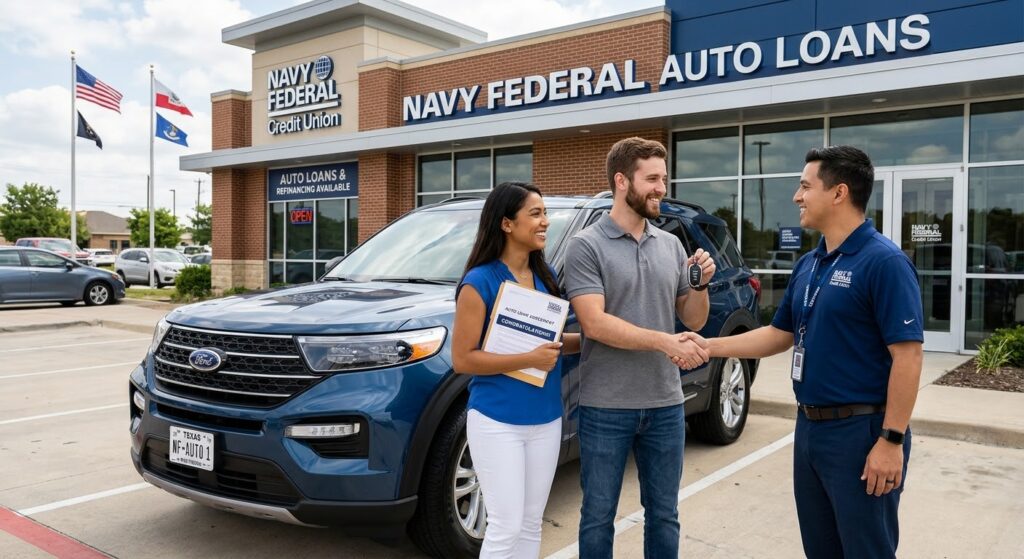
The Credit Union Advantage: Why Structure Matters
To understand Navy Federal’s auto loans, you must first understand the entity behind them. Unlike traditional banks, Navy Federal is not owned by Wall Street investors; it is owned by its members. This structural difference fundamentally alters how interest rates are calculated and how profits are distributed. In a traditional bank, the goal is to maximize net income for shareholders. This often leads to higher interest margins on loans and lower yields on savings accounts. In contrast, a credit union operates on a not-for-profit basis. Any surplus earnings are returned to members in the form of lower loan rates, higher savings rates, and reduced fees.
For an auto loan borrower, this translates directly into tangible savings over the life of the loan. Because Navy Federal has a massive asset base—making it the largest credit union in the United States—it can secure funding at very low wholesale rates. These savings are passed down to the borrower. While a national bank might offer a 6.5% APR for a borrower with good credit, Navy Federal might offer 4.9% or lower, depending on market conditions. Over a five-year term, this difference can amount to thousands of dollars in interest saved. This is not marketing fluff; it is the direct result of the cooperative business model.
Eligibility: More Than Just the Military
A common misconception is that you must be active duty military to get a Navy Federal auto loan. While the core membership is indeed tied to the military community, the eligibility criteria have expanded significantly over the last two decades. Today, you can join Navy Federal if you served in any branch of the U.S. armed forces, including veterans, retirees, and even certain government employees. Furthermore, membership extends to family members of existing members, regardless of whether those family members have a military background.
This broad eligibility pool creates a highly competitive internal market. Because Navy Federal has such a large number of potential borrowers, they can afford to be more aggressive with their rates. They do not need to charge exorbitant rates to cover risk because their member base is statistically stable and loyal. For a borrower, this means access to prime-rate lending conditions even if their credit profile is merely “good” rather than “excellent.”
However, eligibility is just the door opener. The real value lies in the loan structure itself.
Loan Structures: New vs. Used vs. Refinancing
Navy Federal offers three distinct pathways for auto financing, each with its own nuances.
New Vehicle Loans
For new cars, Navy Federal often partners directly with manufacturer captive finance arms (like Toyota Financial or Ford Credit). This allows them to offer special promotional rates, sometimes as low as 0.9% or 1.9% for qualified buyers during holiday sales events. The advantage here is convenience; the loan is often processed at the point of sale, meaning you don’t have to wait for external approval. However, these rates are usually tied to specific models and trim levels, so shoppers must read the fine print to ensure the car they want qualifies for the promo rate.
Used Vehicle Loans
The used car market has been volatile in recent years, with prices soaring and interest rates fluctuating. Navy Federal handles this by offering fixed-rate loans for used vehicles up to 84 months (seven years). This is a significant advantage over many banks that cap used car loans at 72 months. Extending the term to 84 months lowers the monthly payment, which can be crucial for budgeting. However, borrowers should be cautious: while the monthly payment drops, the total interest paid over the life of the loan increases. Additionally, Navy Federal places strict limits on the age and mileage of the vehicle. Generally, the vehicle cannot be older than ten years and must have less than 125,000 miles. These restrictions help manage risk but may exclude older, high-mileage cars that other lenders might accept.
Refinancing Existing Loans
One of Navy Federal’s strongest selling points is its refinancing program. If you bought a car from a dealership using dealer financing, you can later refinance that loan through Navy Federal to get a lower rate. This is particularly useful if your credit score has improved since the original purchase or if market rates have dropped. Navy Federal allows refinancing on both new and used cars, provided the vehicle meets their age and mileage criteria. The process is entirely online, and approval can happen in minutes, not days.
The Application Process: Speed and Transparency
Applying for a Navy Federal auto loan is notably streamlined compared to traditional banks. The entire process can be completed online, from application to funding. One unique feature is their pre-qualification tool, which allows you to check your rate without a hard credit inquiry. This is a critical distinction. Many lenders will pull your credit report multiple times during the shopping phase, temporarily lowering your score. Navy Federal’s soft pull lets you shop around without penalty.
Once you submit a full application, the decision is often instant. If approved, funds are typically deposited into your checking account within one to two business days. For in-person purchases, this speed allows you to act quickly when you find a car you love, rather than waiting for weeks for underwriting.
Another unique aspect is their lack of prepayment penalties. Whether you pay off your loan early or refinance later, you won’t be charged extra fees. This flexibility is rare among some subprime lenders who lock borrowers into long-term contracts.
Hidden Fees and Costs: What to Watch Out
Despite their reputation for low rates, Navy Federal auto loans are not entirely free of costs. Borrowers should be aware of several potential fees:
- Title and Registration Fees: These vary by state and are collected by the DMV, but Navy Federal may add a small administrative fee for processing the title transfer.
- Late Payment Fees: If you miss a payment, you’ll incur a late fee. However, Navy Federal is known for being somewhat lenient with grace periods, though this can vary by loan type.
- Gap Insurance: While optional, gap insurance is highly recommended for new cars. Navy Federal offers it, but it may be more expensive than purchasing it separately through an insurance provider. Borrowers should compare costs before adding it to their loan.
- Prepayment Impact: While there’s no penalty for prepaying, paying off a loan early means you stop paying interest sooner. However, if you plan to sell the car, ensure you have enough equity to cover the remaining balance.
Customer Service: The Human Element
In an era where most banking is done via apps and chatbots, Navy Federal prides itself on human-centric customer service. Members can call a dedicated support line for auto loans and speak to a real person quickly. This is particularly valuable when dealing with complex issues like payoff statements, lien releases, or disputes over vehicle valuation.
Moreover, Navy Federal offers digital tools that enhance the borrowing experience. Their mobile app allows you to make payments, view your balance, and even download your payoff statement instantly. For those who prefer automation, automatic payments can be set up easily, ensuring you never miss a due date.
Who Should Choose Navy Federal?
Navy Federal auto loans are ideal for:
- Military members and veterans who already have membership.
- Budget-conscious buyers looking for the lowest possible interest rate.
- Refinancers who want to lower their monthly payments or shorten their loan term.
- First-time buyers who appreciate transparent terms and no hidden fees.
However, they may not be the best fit for:
- Buyers with poor credit who might find better options with specialized subprime lenders.
- Those buying very old or high-mileage vehicles that exceed Navy Federal’s age/mileage limits.
- People who need immediate funding (same day) for a private party sale, as standard processing takes 1–2 days.
Conclusion
Navy Federal’s auto loans represent a blend of traditional reliability and modern efficiency. By leveraging their credit union structure, they offer rates that are consistently competitive with, and often better than, major banks. Their eligibility expansion has made these benefits accessible to a wider audience, while their flexible loan terms and strong customer service keep them relevant in a crowded market. For anyone seeking a straightforward, low-cost auto loan, Navy Federal remains a top-tier option worth considering.
Disclaimer: The information provided in this article is for educational purposes only and does not constitute financial advice. Interest rates, fees, and eligibility criteria for Navy Federal auto loans are subject to change without notice. Rates mentioned are illustrative and based on general market trends; actual rates will depend on your credit score, loan term, vehicle type, and current market conditions. Always review the official Navy Federal Credit Union website or contact a representative directly for the most accurate and up-to-date information. This article is not affiliated with or endorsed by Navy Federal Credit Union.